
On the morning of September 11, 2001, millions of Americans watched an ordinary Tuesday become one of the darkest days in the nation’s history.
The cover of President Bush’s schedule. September 11, 2001. pic.twitter.com/TI5YrNF1Ul
— Ari Fleischer (@AriFleischer) September 11, 2013
https://platform.x.com/widgets.js
Nineteen al-Qaeda terrorists hijacked four commercial airplanes. Two were deliberately flown into the Twin Towers of the World Trade Center in New York City. A third struck the Pentagon in Arlington, Virginia. Passengers and crew aboard United Airlines Flight 93 fought back against the hijackers before the plane crashed near Shanksville, Pennsylvania.
[youtube https://www.youtube.com/watch?v=-ZxtI1GICQQ?si=ndbJBQ4Um1VB4DV_&w=560&h=315]
By the end of the day, 2,977 innocent people had been killed—2,753 in New York, 184 at the Pentagon and 40 aboard Flight 93. Thousands more were injured, families were shattered, and an entire nation was left confronting grief, fear and questions that could not be answered by politics, military power or human reason alone.
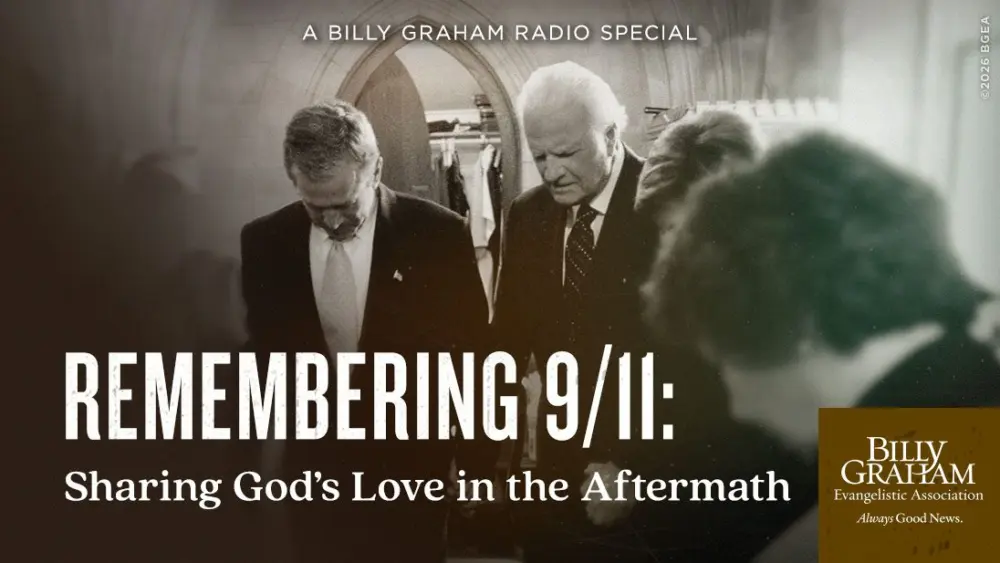
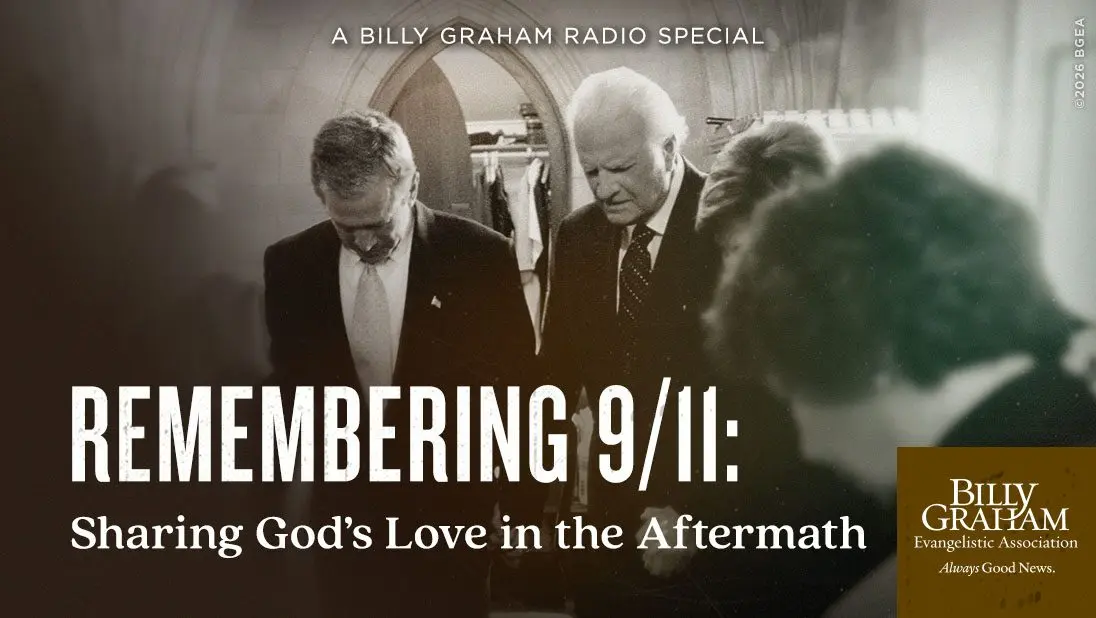
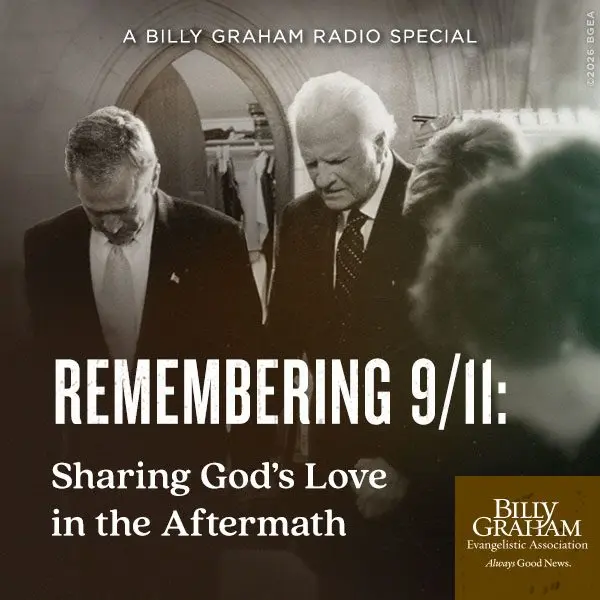
As America approaches the 25th anniversary of the attacks, the Billy Graham Evangelistic Association is looking back at the Christian response to that extraordinary moment through the special radio program Remembering 9-11: Sharing God’s Love in the Aftermath.
A Nation Searching for Answers
The days immediately following September 11 were marked not only by grief but also by an unusual sense of national unity. Churches filled. Americans gathered for prayer. Political and cultural differences that had seemed so important only days earlier suddenly appeared much smaller in the shadow of tragedy.
Americans were also asking some of humanity’s oldest questions: Why does evil exist? Why does God permit suffering? Can God still be trusted when everything familiar seems to collapse?
Three days after the attacks, President George W. Bush declared September 14, 2001, a National Day of Prayer and Remembrance. Billy Graham was asked to address the nation from Washington National Cathedral.
Graham did not pretend that Christianity offered a simple explanation for every tragedy. He acknowledged the mystery of evil and the limitations of human understanding. But he pointed a grieving nation toward something deeper than an explanation: the character of God.
Even when life is at its darkest, Graham argued, God remains sovereign, loving, merciful and compassionate.
A Foundation That Could Not Collapse
The images of September 11 seemed almost impossible to comprehend. Buildings that had dominated the New York skyline collapsed within hours. Smoke covered lower Manhattan. Firefighters, police officers and ordinary citizens ran toward danger while thousands desperately tried to escape it.
Graham used the destruction itself to make a spiritual point.
The towers had fallen, but beneath the wreckage their foundations remained. America, he said, faced a similar choice. The country could disintegrate emotionally and spiritually under the weight of fear and anger, or it could rebuild upon a foundation strong enough to endure catastrophe.
For Graham, that foundation was trust in God.
His message was not merely patriotic encouragement. It was explicitly Christian. He pointed listeners to the cross of Jesus Christ as evidence that God is not distant from human suffering.
Christianity teaches that Jesus willingly entered a world of pain, carried humanity’s sin and suffering to the cross, died, and rose again. The resurrection means tragedy does not have the final word. Death does not have the final word. Evil does not have the final word.
That is why Graham could speak about hope even while the ruins of the World Trade Center were still smoldering.
The Heroes of September 11
One month after the attacks, Graham returned to the subject during a crusade in Fresno, California.
He reflected on the new understanding Americans had gained of the word hero.
On September 11, firefighters climbed stairways into burning towers while others fled downward. Police officers, emergency personnel and civilians put themselves in danger for people they did not know. Passengers aboard Flight 93 fought back after learning what had happened to the other hijacked aircraft.
Graham connected those acts of sacrifice with the central message of Christianity.
Jesus Christ willingly gave His life for others.
The Gospel declares that humanity’s deepest problem is not simply political violence, terrorism or war, but sin itself. Scripture teaches that all people have sinned and are separated from God, yet God responded not by abandoning humanity but by sending His Son.
At a moment when Americans had seen extraordinary examples of people laying down their lives for strangers, Graham pointed toward the One Christians believe gave His life for the entire world.
A Ministry Born at Ground Zero
The spiritual response to September 11 did not end with a sermon.
Franklin Graham visited Ground Zero during the recovery operation and encountered grieving families, exhausted first responders and people carrying photographs of missing loved ones.
The need was overwhelming. There were physical needs everywhere—but there were also people who simply needed someone willing to sit beside them, listen to their grief and pray.
A Billy Graham Prayer Center was established near Ground Zero. The experience eventually helped give birth to the Billy Graham Rapid Response Team, a ministry that trains chaplains to provide what the organization calls a ministry of presence during disasters, shootings, storms, fires and other crises.
What began in the aftermath of September 11 has continued for a quarter-century.
According to the Billy Graham Evangelistic Association’s 2026 anniversary retrospective, Rapid Response Team chaplains have now deployed to more than 960 disasters, prayed individually with more than 850,000 people and helped more than 40,000 people make decisions for Jesus Christ.
Something created to minister amid the wreckage of one terrible day has consequently carried the Gospel into hundreds of later scenes of suffering.
The Question September 11 Still Asks
Twenty-five years can make history feel distant.
An entire generation of Americans is now reaching adulthood with no personal memory of watching the Twin Towers fall. For them, September 11 may appear primarily in textbooks, documentaries and anniversary ceremonies.
But the spiritual questions raised that morning have not changed.
Life remains uncertain.
Death remains unavoidable.
Evil remains real.
And every person still must decide where to place his or her ultimate hope.
Franklin Graham brings the special program to that deeply personal question. People carefully prepare for education, careers, homes and retirement, he observes, while often avoiding preparation for the one certainty every human being eventually faces: eternity.
The Christian answer to that problem is Jesus Christ.
Scripture teaches that sin separates humanity from God, but that Christ died for sinners and rose from the grave. Salvation cannot be earned through good works, religious membership or human achievement. It is received through repentance and faith in Jesus Christ.
That was Billy Graham’s message to a wounded America in 2001.
It remains the message today.
Remember—and Hold Fast to Hope
“Prayer is the Christian’s greatest weapon.” —Billy Graham
— Billy Graham (@BillyGraham) January 17, 2026
https://platform.x.com/widgets.js
The 25th anniversary of September 11 is an opportunity to remember 2,977 lives taken in an act of terrorism, the families who carried their loss forward, the first responders who ran toward danger and the countless Americans who served their neighbors during the days and months that followed.
It is also an opportunity to remember how quickly the assumptions of ordinary life can disappear.
Billy Graham stood before the nation three days after the attacks without claiming to possess every answer. Instead, he pointed Americans toward the hope that had defined his ministry for decades: Jesus Christ.
Buildings may fall. Nations may face tragedy. Circumstances can change in a single morning.
But the Gospel declares that God has provided a foundation that cannot be destroyed.
Listen to Remembering 9-11: Sharing God’s Love in the Aftermath and hear Billy Graham and Franklin Graham reflect on tragedy, heroism, faith, eternity and the hope found in Jesus Christ.
If you are searching for that hope or would like to learn more about beginning a relationship with Jesus Christ, visit FindPeaceWithGod.net.