Colorado History and Philanthropy at the Molly Brown House Museum
Molly Brown House / Pinpoint Colorado
Located in the heart of Denver, the Molly Brown House Museum stands as a testament to both architectural magnificence and the indomitable spirit of its namesake, Molly Brown. Renowned for surviving the Titanic disaster and her subsequent advocacy efforts, Brown’s home reflects the opulence of the late 19th century and her family’s rise following the gold strike in Leadville, Colorado. Built in 1889, this Victorian mansion became a sanctuary of modern conveniences for its time, showcasing the wealth and ambition of its proprietors.
Andrea Malcolm, Vice President and Museum Director, offers a rich tapestry of insights as she shares the story of the Browns moving into the house after the Little Johnny gold strike. The entryway of the home epitomizes their pride, embellished with gold and eclipta, a nod to their good fortune and hard work. However, Molly Brown’s story extends far beyond her material success and is marked by her compassionate activism, particularly after the Titanic tragedy.
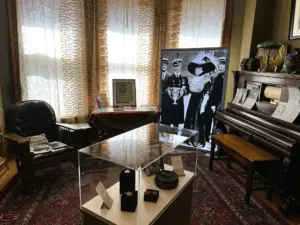
Relics from Brown’s Titanic trip are peppered throughout the museum
The Titanic section within the museum delves into this defining moment. As war raged between the rigid class structures, Molly Brown emerged as a pivotal figure advocating for immigrants and third-class passengers who suffered disproportionately. Spearheading efforts on board the Carpathian, she raised substantial funds and rallied a committee to hold the White Star Line accountable. Her tenacity in fighting for justice highlighted her as a staunch opponent of societal inequities and unnecessary tragedies.
Transitioning from luxury to a vital community resource, the mansion’s history didn’t end with the Browns. The house became a boarding residence during the Great Depression and evolved further in the 1960s when it was transformed into a home for young girls coming through the juvenile court system. This adaptation speaks volumes about its continued social relevance and the enduring legacy of its occupants.
Today, the museum offers both guided tours and self-exploration options. Interactive displays and activities invite visitors to immerse themselves in the stories held within its walls. From scavenger hunts to historical deep-dives facilitated by knowledgeable docents, the Molly Brown House remains a beacon of communal learning and engagement.
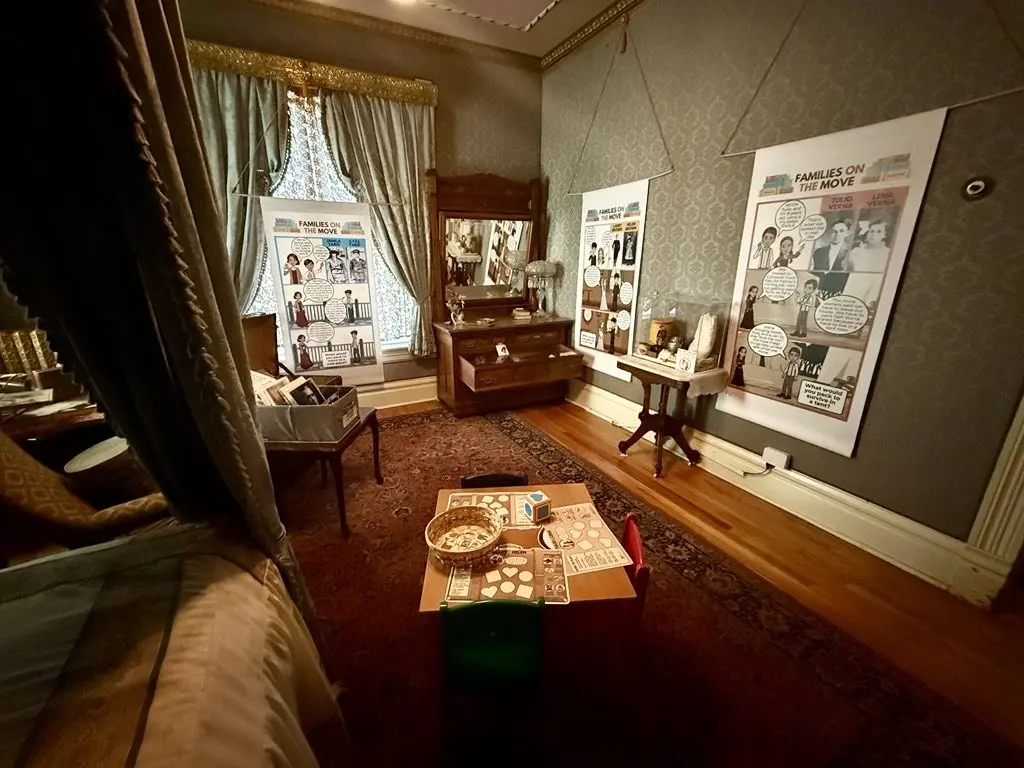
The home served as a refuge for transient families during the Great Depression and after / Pinpoint Colorado
The museum, open seven days a week, is not only a tribute to history but also an educational hub. It embraces visitors with diverse initiatives, emphasizing the past’s value in informing our present and future. As Andrea Malcolm notes, the museum sustains a vibrant connection to community activism, echoing Molly Brown’s commitment to social causes from women’s suffrage to consumer protection.
As visitors walk through the rooms, they find more than mere remnants of the past; they encounter stories of strength, humor, and an unyielding optimism to forge a better world. Molly Brown’s legacy, encapsulated in this house, is a rich reminder of history’s ability to educate, inspire, and transform. Her story is one that beckons both reflection and action, urging guests to write their chapters of resilience and righteousness.
Every Coloradan should experience the Molly Brown House, and it’s perfect for school field trips, homeschool trips, family weekend outings, or private group events. The museum is open Tuesday to Saturday 10AM-5PM (Extended hours on Thursdays until 7PM!), and Sundays 12PM-4PM. Guided tours are available or you can walk it at your pace. The museum encourages purchasing tickets ahead of time, so purchase tickets to the Molly Brown House in Historic Denver today!
Join us on a captivating journey through Denver's historic Molly Brown House Museum. In this episode, host Rachel Mains is joined by Vice President and Museum Director Andrea Malcolm as they delve into the fascinating life and legacy of Molly Brown. From her iconic Victorian mansion to her fearless advocacy following the Titanic disaster, discover how Molly Brown's courage and determination transformed both her home and her community.
00:00:00 Introduction to the Molly Brown House Museum
Welcome to Pinpoint, Colorado. I'm your host, Rachel Mains. Well, today we have the pleasure of showing you one of Denver's most iconic and historic homes, the Molly Brown House Museum. Coming up, I'm joined by Vice President and Museum Director Andrea Malcolm for a behind-the-scenes look on the legacy of Molly Brown. Well, thank you, Andrea, for allowing me to come here. This is my first time here and I got to say, just coming inside, I'm like, wow, I can't wait to check out all the rooms.
SPEAKER 01 :
Yes, we have a beautiful 1889 Victorian mansion that Mr. and Mrs. Brown lived in just after their tremendous gold strike in Leadville, Colorado in 1893. They loved this house and We talk about it's Colorado because it's made of Castle Rock rhyolite, Manitou sandstone, and it was completely modern with electricity, heat, running water, all of those cool things you want in a house in 1893.
SPEAKER 02 :
Yeah, so this is the place to be, really. This was the neighborhood, and they designed their houses in a Victorian-type style.
SPEAKER 01 :
Yeah, this was Quality Hill or Capitol Hill, so this was the neighborhood that popped up as the state capitol is coming up the hill, whereas most of downtown had been downtown. When we think about lower downtown, we think about Auraria Campus, which was the original town of Auraria. So Denver's creeping up the hill at this point. You're a little bit out of the dirt and the smog, and then you have the gold strike and the silver strikes that are happening. And so folks are building these big mansions up here on the hill. Does she have anything in the home that signifies that she won gold? So the Browns, I mean, Mr. Brown had been in the mining industry for over two decades at this point. He worked his way up as an engineer, a foreman, before they were able to quietly orchestrate the strike at the Little Johnny, which took them almost a decade. So No one really was clear about how much gold was coming out until the newspapers sort of busted the story in October of 1893, where they reported that over a thousand tons of gold were coming out of Little Johnny a day. Wow. So then the Browns, they pack up, they moved down here to Denver in early 1894. They purchased this house from the Larges, who were the first family to own it after it was built. One of the first things the Browns did was when you walk into the front entryway of the home, you walk through this large creaking wood door, and then you're surrounded, ceilings and walls with gold and eclipta. Wow. And that's their way of reflecting their tremendous pride in all of that hard work and that gold strike.
SPEAKER 02 :
She has such an interesting life. Of course, we're all familiar with the unsinkable Molly Brown and the Titanic. What are some things to highlight with that? I know you have a Titanic room here, but just some key points here.
SPEAKER 01 :
I think the thing that Mrs. Brown really in the aftermath wanted people to understand was number one, It seemed like there was no reason for the tragedy. And number two, the class system and sort of how people segregated themselves on the ship and then as it was sinking in the aftermath, she felt was also unnecessary. You know, it was the third class passengers who were more likely to be immigrants coming to the United States to start a new life. Their lives are suddenly disrupted. They most likely lost a husband or a son because they were told to stay behind or entire families chose to stay behind. So that new life that they were going to start changed. had a tragic and quick end. And so for Mrs. Brown, she really wanted to make sure it was those folks who were helped and attention was drawn to their plight. So she helped raise $10,000 before they even got to New York City when they were on the Carpathian. and really spoke out not only against the class system, but against sort of the white star line for how they handled the disaster. But she was joined by a committee of people from the ship who joined her in speaking out against what had happened and making sure that those folks were cared for. Yeah.
SPEAKER 02 :
Well, yeah, so tragic, but she definitely took that tragedy and made some beauty into it. You showed me briefly, and I'm going to go up there and take a greater look later, about this room that was dedicated to helping young ladies.
SPEAKER 01 :
Mm-hmm. So after Mrs. Brown passed away in 1932, this is the height of the Great Depression, this house was turned into a boarding house. It was an apartment building, so the rooms were subdivided, the house was broken up, and this was affordable housing for multiple families over the next couple decades. And then in the 1960s, the gentleman who owned the home, Art Leisenring, He rented it out to the city and county of Denver and Judge Ted Rubin, and they operated a home for girls out of this house for three years. So girls lived here throughout the house. There was a house mother who lived here with them. And those were girls who were coming through the juvenile court system who just needed a little bit extra support. They didn't need to be in prison. They didn't need to be in giant orphanages or anything like that. They just needed a little hand up. Judge Rubin ran this program out of the home. And we have since come to know and meet some of these young women and learn how they went on in life. Some of them do amazing things. So we really want to honor that part of the House's history. And Judge Rubin himself was influenced by Juvenile Court Judge Benjamin Barr Lindsey. And Mrs. Brown was his primary fundraiser. So there's this beautiful connection to the story. So You might be in a Victorian home, but by the time you get to the third floor, you're seeing a 1960s girl's bedroom. You're seeing Tiger Beat magazine and hearing the Beatles and, you know, that whole life chapter of this house.
SPEAKER 02 :
Yeah. That's wonderful. What's your favorite room in the house?
SPEAKER 01 :
I love actually the room we're in right now. So this room has always been interpreted as Mrs. Brown's room. So we have the green fabric on the walls, the beautiful swirly green carpet on the floors, gold lace hangings. We have a lot of her things in here. We have dressers and desks and jewelry. And I think it just gives you that moment where you can... Sort of stop and step and put yourself into her shoes a little bit. And what would a life have been like for her as a woman of means and privilege, but understanding that so much of her life's work was going towards others. Right. She's really about the community. Yeah.
SPEAKER 02 :
And I think she would smile to see. now what it's become and that people are coming to book tours. Tell us about the tours and how we can do that.
SPEAKER 01 :
Absolutely. This time of year, we're open six days a week. The rest of the year, we're open seven days a week. Depending on when you come and visit us, we're open. You can do a self-guided exploration where you can explore all four levels of the home. We have great interactive activities, family-friendly activities, including scavenger hunts for kids, We have videos you can watch, things you can listen to. You could interact and leave your comments and just a great way to explore the house and have conversations with friends. Or you can join one of our amazing docents who will take you through the house and tell you the story of Mrs. Brown, the community activism that she was involved in. And then when you're done with the guided tour, you can still explore on your own if you'd like.
SPEAKER 02 :
That is quite unique to guided tours and other spots, right? You can just go with the tour guide and now hearing and learning that, hey, you know, you could be here as long as you like and you can really spend the time that you like in each room. Now, we know that she was a Spitfire, but what's your favorite qualities about her? her personality as you've learned about her and been here for so many years.
SPEAKER 01 :
Yeah. First and foremost, she was raised and herself believed in the power of education. That education really got you somewhere and got her kids somewhere. And between her and her husband, JJ, they pretty much made sure every niece, nephew, cousin, relative in the family received a good education. She knew that was how you uplift yourself. yourself and your family. But then she had this sort of great sense of humor where we're able to read her letters, her quotes in newspapers, and she had a pretty sharp wit to her, you know, and so we are able to draw on Her words herself, the things that she had to say in response to what happened in 1914 in southern Colorado when miners went on strike and unfortunately the militia came in and set fire to the tent colony. And women and children were lost, unfortunately. Mrs. Brown stood up to John D. Rockefeller Jr. and his son and said, you know, aren't we forgetting our Sunday school lessons when we learned that, am I my brother's keeper? You know, so she always had these great responses. Or she had a gentleman in the newspaper was reporting how a gentleman kept flirting with her at a social event. And he wanted to take her for a drive in his car and they would go fast. And she said, sir, when I want to go to hell, I'll call for you. You know, so she's got this whole range of wit and response that sometimes was probably a little bit too outspoken or a little too gauche for society. But she said it anyway. Yeah.
SPEAKER 02 :
What a great lady. Yeah. I mentioned to you when I arrived how fun this career is. For those who are listening who would love to be a museum director, what are some tips?
SPEAKER 01 :
I mean, it's so amazing these days. You can go and get master's degrees in museum studies, or you can just get your history degree. There's so many different pathways into working at a museum. There's museum education. So you can go to school like anyone else who wants to become a teacher or educator, but then your pathway takes you to a museum. We have a robust education department where we serve over 10,000 local school kids a year. We go out primarily to the classroom with a set of bilingual programs where Third and fourth graders learn all about their Denver and Colorado history and then get to learn about Mrs. Brown in English and Ana Espanol. So we have all of those programs. And really, it's just a love of being in a historic setting. And right now, it's understanding how important history is. when we look at understanding the past so that that informs the decisions and choices we're making today and gives us a glimpse of where things might head in the future and just gives us hope that solutions were found to these problems in the past or these issues were resolved in these ways and we've overcome some of our difficulties as a country, perhaps things like systemic racism. How did we do that? Let's look to the past. So I love being able to have people come to the museum and see that collective action, that community that Mrs. Brown surrounded herself when it came to achieving the right to vote for women and women of color, for doing things like making sure that milk is safe to drink or kids don't work in factories anymore. So all of those things that women like her did 100 years ago, what can we as women and citizens and people of Denver do today? Right.
SPEAKER 02 :
And this is such a gem. And you pointed to, you know, learning the past, learning the history to inform how we are today is such a treasure. And I think on our phones and we're so, you know, media driven and stuff, we don't take the time with the activities and really appreciate something like this. This is an activity that you can do with your family or singles like myself, you can do. And it's a really great interactive experience. I didn't ask you how long typically does the tour take?
SPEAKER 01 :
Most folks are here just over an hour. So from the start of the tour to self-exploring, it could be an hour to an hour and a half. We have some people who spend hours in the house because it can be a place of just sort of contemplation and respite. We have friends who come, you know, 20 somethings who are just hanging out in one of the rooms and having a great conversation or an older set of women who are in the kitchen talking about how their grandma made this special recipe that they remember. So we love people to come, have conversation, just be in the spaces and just find that moment where you know that there's hope and that you're being inspired by that story or having a great memory. Right.
SPEAKER 02 :
Yeah. Well, I have so many more questions, but our time is coming to an end here. So I'm just going to have to learn as I tour the home. And for the listeners as well, give the website real quick so people can get tickets, book a tour, everything they got to do.
SPEAKER 01 :
So visit mollybrown.org. That's where you can find how to get tickets when we're open. You can learn about all of our great special events we do. We have lots of evening and weekend events. We're open late on Thursdays, thanks to the Scientific and Cultural Facilities District. So $10 after four on Thursday. So if you work, you can still come over. We have great family programs, all the things. So mollybrown.org. Perfect. Thank you so much. Yeah.
SPEAKER 02 :
My thanks to Andre Malcolm and team at the Molly Brown House Museum for sharing this Colorado story so beautifully. To plan your visit and learn more, go to mollybrown.org. For Pinpoint Colorado, I'm Rachel Mains. See you next time.