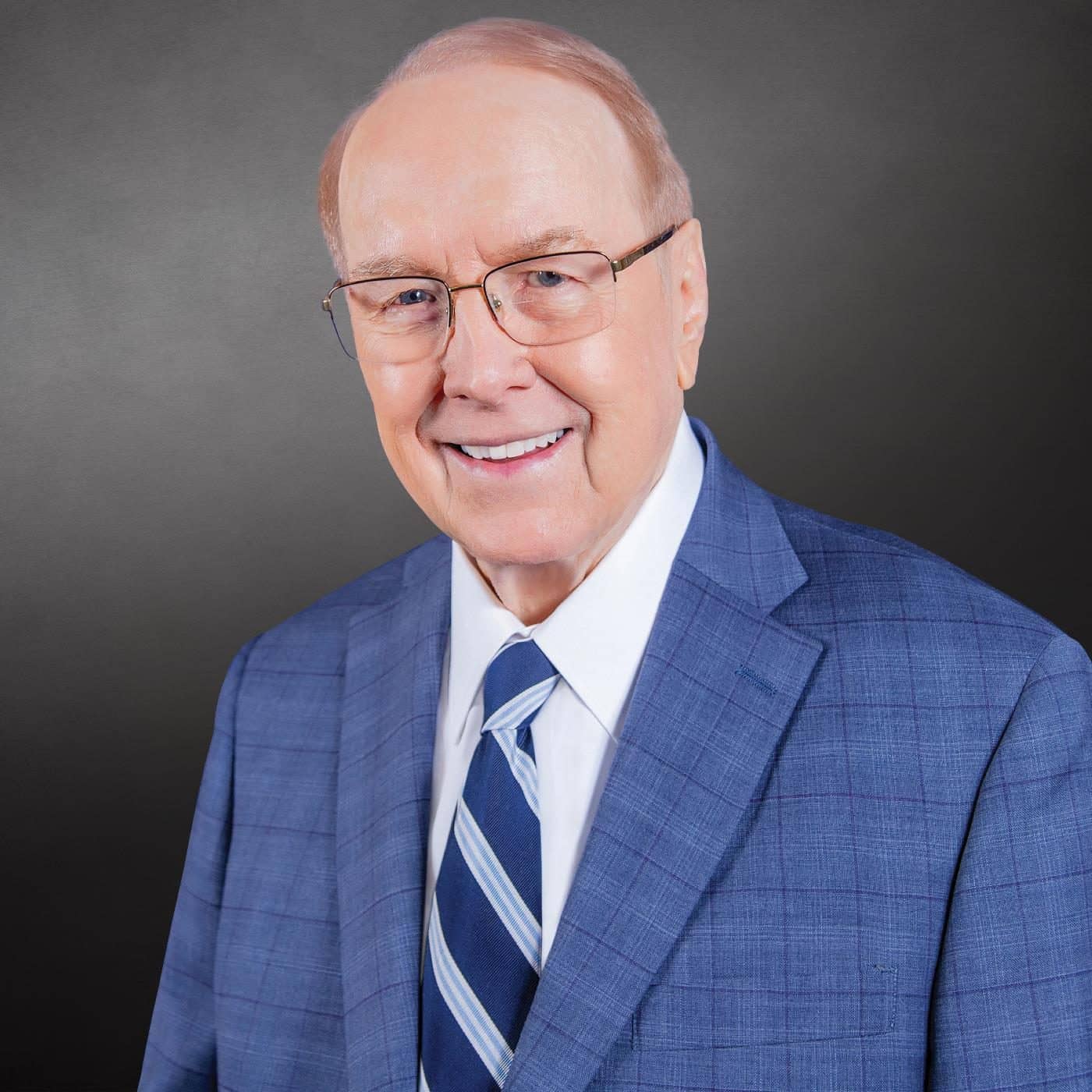

Are we living in the last days? On today’s edition of Family Talk, Gary Bauer welcomes Pastor Gary Hamrick to discuss his groundbreaking book, Standing on the Edge of Eternity. He shares biblical insights about Revelation’s prophecies, the rise of technology in end times events, and why Christians can live with hope instead of fear. To support this ministry financially, visit: https://www.oneplace.com/donate/707/29
SPEAKER 04 :
Hello, everyone. You’re listening to Family Talk, a radio broadcasting ministry of the James Dobson Family Institute. I’m Dr. James Dobson, and thank you for joining us for this program.
SPEAKER 03 :
Welcome to the Dr. James Dobson Family Talk, the broadcasting ministry of the James Dobson Family Institute. I’m Gary Bauer, Senior Vice President of Public Policy at the Dobson Policy and Culture Center. I’m also the host of the Defending Faith, Family, and Freedom podcast. Well, we live in challenging times. The recent assassination of Charlie Kirk and the ongoing attempt we all are familiar with of trying to label normal Christian theology as hate speech. Well, all that kind of thing can lead us feeling vulnerable and uncertain about the future. You know, you’re going to want to listen to this broadcast because fortunately, we can take heart knowing that God has made his plans known to us about what the future holds. He’s given us instructions well in advance so we can live with hope and expectation for what lies ahead rather than wallowing in fear. Fear not is one of the most frequent commands of the Bible. Our guest today, Pastor Gary Hamrick, has been preaching the good news of the Bible for nearly four decades. He recently wrote an outstanding new book, A Guide to Understanding Vital Biblical Teachings About Earth’s Final Days, The Millennial Kingdom, and Heaven, as recorded in the book of Revelation. Its title is Standing on the Edge of Eternity. What a fantastic title because we all as individuals are standing on the edge of eternity, and so is planet Earth in its own way. I believe when you hear Pastor Hamrick today, you’re going to come away with a much deeper appreciation for the clarity, authority, and awe-inspiring message of the Bible’s final book. Pastor Hamrick began his full-time pastoral ministry in 1987. He then survived four years as a youth pastor. Congratulations, Pastor.
SPEAKER 02 :
Thank you.
SPEAKER 03 :
Gary then brought together a group of 18 dedicated believers to found Cornerstone Chapel in Leesburg, Virginia. Cornerstone is on fire. It’s grown to now serve as the church home for thousands of worshipers each week on campus. With thousands more watching online, including me and my wife, Carol, we consider Pastor Hamrick to be our pastor, whether he fully realizes that or not. Pastor Hamrick serves on the board of directors of the Museum of the Bible, as well as the Family Research Council, which I was pleased to lead for over a decade. His radio program, Cornerstone Connection, airs on over 600 stations nationwide each weekday. Gary and his wife, Terry, have been married since 1987. They’re the proud parents of three adult children and nine grandchildren.
SPEAKER 02 :
Yeah, nine grandchildren now.
SPEAKER 03 :
Pastor, welcome back to the Dr. James Dobson family talk. Before we get going, I had the occasion a couple of times in recent years before Dr. Dobson passed away to tell him about what you were doing at Cornerstone. And he was so excited about that because a lot of what you’re doing is this whole concept of Christian citizenship with Christians. which, of course, Dr. Dobson devoted his whole life to. But he was just so excited that your church, just a few miles from the center of power in the most powerful nation in the world, understood all of that. And I’m not sure I ever adequately passed it on to you. He wanted me to make sure that he was praying for you and thought you were doing great work.
SPEAKER 02 :
Well, thank you for passing that on, Gary. I did not know that. Regret I have that I never had an opportunity to meet Dr. Dobson, but certainly respected him and loved him from a distance. And what he and Shirley have done to impact the kingdom really around the world is just immeasurable. And we’ve lost a real asset to the kingdom on earth, but his work continues and his legacy continues to impact, I know, thousands and thousands of people around the world still.
SPEAKER 03 :
Well, thank you, Pastor. Those are kind words and true words for sure. I met Dr. Dobson when I was in trouble in the Reagan administration. I had said something, in retrospect, probably unchristian, and he called me because he realized I was in trouble and put me on the radio show and kind of saved my ongoing career in government. So it was a nice moment.
SPEAKER 02 :
You can tell me offline what you said.
SPEAKER 03 :
I don’t know. I’ve been trying to forget it, actually. Pastor, before we get into this book, and man, what a timely book. There’s so much confusion, you know, about the prophetic parts of the Bible and certainly about the book of Revelation. But staying on this question of Christian citizenship, I want to give you a chance to comment on something. I was so excited when after Roe versus Wade was overturned that you did what a lot of other pastors didn’t do, which was celebrate the moment in the Sunday after that decision. Yeah. And then recently when Charlie Kirk was assassinated, I actually wrote about a pastor, you know, speak up. This is a moment you’re hurting church. We’ll want to know that a follower of Jesus Christ just got struck down. And you did that again at Cornerstone Chapel. What moved you in both of those cases? And why do you think some churches, many churches, didn’t see fit to say anything on either occasion?
SPEAKER 02 :
Well, for me, Gary, there’s a saying that I read once that Martin Luther made, and it has just always challenged me. And Luther said, if you preach the gospel in all aspects, with the exception of addressing the issues of your time, you are not preaching the gospel at all. And so I hear sometimes pastors say, I’m just going to preach the gospel, just going to preach the gospel. Well, first of all, it’s good if you can get pastors to preach the gospel, because unfortunately, too many churches have gone so woke, they’re not even doing that much. But sometimes pastors fall back on just the phrase, I’m preaching the gospel, that’s all I want to do, because they are too reluctant to address the issues of their time. And I think it’s important that pastors get up in the pulpit. I mean, historically, when you look at just the history of our country and predating even to the colonial period where pastors would get up in their pulpit. They would address the issues of their time. They would speak about the candidates running for office. They would call people to be engaged in their communities. I just think all I’m doing is what is historically true in America. And what’s biblically true in Scripture, you look at the various prophets who were raised up and they addressed the kings, they addressed the issues of their time, they spoke truth to power. So I just don’t see it any other way. I think it is our responsibility as pastors to teach the whole counsel of God’s Word while at the same time addressing the issues of our day that are so relevant. And to your question as to why… Some churches just don’t. I think often it comes down to the two issues of numbers and money. Pastors are afraid they’re going to lose people, and they’re counting heads, and they’re counting dollars, and they think that if they speak up about some of these issues, some of which, according to the culture, are considered controversial—they’re not controversial, it’s just, you know— how the culture perceives it. But pastors then think, oh, people are going to leave my church and with them, they’re going to take their money. And Gary, I have found the opposite. I have found that the churches that are really preaching truth these days are meeting a need. There’s a great thirst and hunger for truth in America, probably around the world, but just, you know, our own country for sure. And so people are flocking to churches, and they are wanting to know the truth. They may not always agree in the sense of they may not always align with what they’re hearing from the pulpit, but they are at least interested, curious. They want somebody to tell them the truth, and that is the role and responsibility of pastors.
SPEAKER 03 :
Yeah. America is planted so deeply in the roots of Judeo-Christian civilization. I mean, the founders, almost everything they wrote springs out of that. And so it was a great blessing for each of us when we were born here compared to all the places you could be born, right? So if God gives us a great gift of being in this country— You’re an ingrate if you don’t try to take care of the gift. And there’s not a problem America’s facing that can be solved without the input of Christians. That’s absolutely clear. Well, Pastor, this book on Revelation is—I’m not finished, but I’m eagerly reading it, and I love it. I was reminded that the book itself is responsible for some of the divisions in Christendom, right? People get into really heated arguments about post this or pre that and when this happens and so forth. I actually had somebody that I love, Pastor, say to me not too long ago, you don’t actually believe Revelation is literal, do you? And I said, yeah, I believe it as much as I think of Genesis 1-1 when it says God created the heavens and the earth is literal. So, yes, I think it is. But you helpfully deal with this in the very beginning of the fact that there are different ways Three main ways of looking at Revelation. Could you share that with us? Because I think that says a lot about how to approach the book.
SPEAKER 02 :
Yeah, sure. Yeah, typically there are three ways to look at the book of Revelation. One is allegorically. That it’s a book of symbolism, but it is not to be taken literally. And it is to challenge the church and encourage the church by using allegorical language. Then another view is the historical, where you look at the book of Revelation and you think of it entirely as a book of history where the Antichrist was Nero – The early church was persecuted, and that’s the tribulation period of the book of Revelation between chapter 6 and 18. But the best way that I believe that Revelation should be approached is a literal slash futuristic interpretation, meaning that the things in the book of Revelation are literal, and they speak of things that are going to happen in the future. Now, not all of it is necessarily futuristic. I think the first three chapters, actually, when it talks about the seven letters to the seven churches, I think some of that is actually painting a picture of the historical nature of the church over the centuries since Christ ascended back into heaven, and that we are living presently in the time where there’s a divergent stream among the church, which is the difference between the church of Philadelphia and the church of Laodicea. The Church of Philadelphia is the evangelistic church. That is the expectant church for the imminent return of Jesus Christ. The Church of Laodicea, that’s the lukewarm church. That’s the woke church. And we see both streams actually happening today. But by and large, the book of Revelation is about the future, and it is to be interpreted literally. Of course, John uses language that is symbolic because he’s writing in the first century, describing things that are happening centuries down the road. And so he’s trying to use language to communicate all that. So he often says, like horses, like locusts, like a dragon. I mean, he’s using all these similes and these words because he’s struggling in the first century to describe things that he sees into the future. Yeah. It would be like if George Washington were to be handed a cell phone, how would he write about it? How would he describe it using language of the 18th century? I mean, he would say it’s a rectangular shape. It has metal and glass, and I can see people, and I can hear sounds, but… But he would struggle to communicate about something that he wasn’t familiar with. So sometimes people take all the symbolic language and they think, oh, he’s just writing allegorically or he’s writing metaphorically or he’s writing to describe historical things. But no, he’s just using language to write about the future. The Book of Revelation should be seen as a literal book that should be interpreted that way. Now, that’s my opinion, but like you said, look, there are good brothers and sisters who will approach this book differently. I always like to fall back on what Augustine once said, where he said, in essentials, unity, in non-essentials, liberty, and in all things, charity. So, we have to make allowance for the different views that people can have, and they’re still brothers and sisters in the Lord, but I approach this book, I approach Revelation, and I wrote my book from the standpoint of the literal slash futuristic view. Thank you.
SPEAKER 03 :
I love that analogy or that explanation you made in setting up the book that imagining George Washington seeing a big screen TV or a cell phone.
SPEAKER 02 :
Yeah.
SPEAKER 03 :
I mean, how would he even find the words to be able to tell Martha what he just saw at the office that day?
SPEAKER 01 :
That’s right.
SPEAKER 03 :
She’d think he was crazy. Exactly. Yeah. I don’t want to get ahead of the discussion here, but the other thing that’s always been interesting to me in Revelation is that Things are described that are only possible with modern technology. And the thing that comes to mind is the two witnesses that are really incredible characters that we learn about in the Bible. And the way they’re described just blows your mind, right? But when they’re murdered— The book says that the whole world will see them and engage in a great big party because they didn’t like what they were saying. And of course, the time that that was written, the whole world couldn’t see anything at the same time. But now with cable TV, we can.
SPEAKER 02 :
That’s a perfect example. Satellites, cable TV, the internet, it will be broadcast around the world and people will see it. So you’re absolutely right. I think some of these things that we are seeing unfold are… are indicative of the technology of the times. I’ll even go further a little bit on the limb here. I think there’s the possibility that AI plays into Revelation because when the Antichrist sets himself up in the temple and proclaims himself to be God, it says that an image of the Antichrist is set up there. And I think it’s possible that AI technology is involved in all of this too. We don’t know, but… You’re certainly right that some of these things I don’t think could even be happening except that we’re living in a day of such technology.
SPEAKER 03 :
One of the things that we’re told is that people will not be able to engage in commerce. They won’t be able to buy and sell without the mark of the beast or that validation from the powers that be. And we’re seeing a lot of that right now in places like Communist China where there are social scores they give people. And if you get a bad score, you may not even be able to get on a bus and go out of town because your score will come up when you put your card in the bus. And we’re seeing the same trends here today.
SPEAKER 02 :
I remember one time being in a line of a grocery store and this lady had forgotten her wallet and she kind of made a joke. She said, I wish I just had a barcode like imprinted on my forehead so that You could scan it. And I just thought she doesn’t even know what she’s saying. But, man, the time is going to come when that kind of a mark is going to be the way that people buy and sell. For believers who don’t take the mark in the tribulation period, they’re going to be martyred for it. So these are interesting times for sure.
SPEAKER 03 :
They are. Pastor, you know, as long as I can remember, and I was raised in a Southern Baptist church in Kentucky, there has been an inclination in the body of Christ almost instinctively to oppose Christ. world government. You know, there was a lot of people very dubious even in the Christian world when the United Nations was formed. And of course, a lot of what happens in Revelation appears to describe a world government. So people were at one point labeled you know, kind of crazy because they didn’t go along with the world cooperating together. But I think there is strong Christian grounds to be skeptical of world government bringing anything good.
SPEAKER 02 :
Yeah, very true. And I think we got a glimpse of it when the World Health Organization wielded a lot of power during COVID and people began to realize, wow, is even the sovereignty of the United States in jeopardy because we might join this kind of a WHO world kind of a rule? And yeah, the Bible speaks of it. The Bible talks about how The world will be divided into 10 geographical regions, and then those 10 geographical leaders will end up giving their power to a sole leader, to the Antichrist. And so the Bible does tell us at some point there will be a one-world government and a one-world religion. Now, I personally believe that we’re out of here, that the church is raptured before all that, but we are heading towards that. And it is interesting how instinctive it is among people to be opposed to a one-world government because the Bible speaks about it as something that happens under the rule of the Antichrist.
SPEAKER 03 :
Pastor, I think you addressed this. There’s a very good introduction to the book, forward to the book, but there’s been a tendency throughout church history in the United States, because we get overwhelmed with the events of the day, right, whether it’s in colonial America or any moment of where people feel overwhelmed, that that we will look at a book like Revelation and we will take it and put it on top of current individuals and so forth. And the most notable example is people keep thinking they know who the Antichrist is. And some pretty strange people have been labeled the Antichrist. I think there might be an example where you mentioned that even – George Bush at one point, some fundamentalists were. But the one that I remember was Gorbachev, who was the head of the Soviet Union in some very dramatic days, had this port wine birth defect or birthmark on his head. And people saw it as the sign of the beast, perhaps. So we have to be discerning, don’t we?
SPEAKER 02 :
We have to. It wasn’t George Bush. It was Ronald Reagan because his name – No, it was because Ronald Wilson Reagan, his three names have six letters each. And so some people were saying that’s 666, Ronald Wilson Reagan. People get all wigged out about it. And historically, the church has been – scared about the signs of the time instead of being informed about it. You know, I think back to the 1930s when churches in Germany, you know, saw Panzer tanks lining up outside their churches and they thought, okay, Hitler must be the Antichrist. Benito Mussolini must be the false prophet. And then the church in Europe began to check out thinking, okay, this is the end. But, you know, turns out Hitler was an Antichrist, small a. And there have been a lot of antichrists, small a, in the world who have been these dictatorial leaders who have been brutal murderers, Idi Amin and Hitler and Genghis Khan. I mean the list goes on. But there is a one antichrist, capital A. who will appear on the world scene. And some people have asked me, do you think the Antichrist is here now? I don’t know, perhaps. But I do believe that the Antichrist will not rise to world power until the church is first raptured. He might be on the world scene, but I don’t think we’re going to see him come to full power. But he will be this charismatic global leader, this uniter who comes under the guise of peace, but he actually comes to deceive the world. So he’s a real person, and Satan gives him his power and authority. But whether we know who he is now, that is yet to be determined.
SPEAKER 01 :
Understanding what the Bible teaches about the future isn’t meant to frighten us. It’s actually designed to give us confidence and peace. Pastor Gary Hamrick did a wonderful job helping us see that today here on Dr. James Dobson’s Family Talk. And personally, I can’t wait to continue this conversation with him next time. To listen to any portion of today’s broadcast you might have missed, you can go to drjamesdobson.org forward slash family talk. You’ll find the audio there as well as information about the brand new book by Gary Hamrick. While the worldwide impact of the James Dobson Family Institute doesn’t happen by accident, it takes resources, commitment, and supporters who refuse to stay silent while our culture abandons God’s word. And that’s where you come in. If you believe in what we’re doing here at the JDFI, we encourage you to partner with us. Make a secure donation online when you go to drjamesdobson.org. That’s drjamesdobson.org. You can also make your tax-deductible donation over the phone when you call 877-732-6825. Or if you’d prefer to write, our ministry mailing address is Dr. James Dobson’s Family Talk, P.O. Box 39000, Colorado Springs, Colorado, the zip code 80949. Once again, that’s P.O. Box 39000, Colorado Springs, Colorado, 80949. And if you’re looking for even more trusted content from JDFI, we have put together a 10-day email series called When God Doesn’t Make Sense. It tackles those moments when life feels impossible and God’s plan seems completely unclear. If you’ve ever struggled with doubt during hard times, and let’s be honest, we all have, this series will help you stand firm. It’s built on Dr. Dobson’s classic book, When God Doesn’t Make Sense, and the email series is absolutely free. You can sign up today when you go to drjamesdobson.org and search for that title, When God Doesn’t Make Sense. That’s drjamesdobson.org and look for the words, When God Doesn’t Make Sense. Well, I’m Roger Marsh, and on behalf of Gary Bauer and all of us here at the JDFI, thanks so much for listening today. Be sure to tune in again next time for part two of Gary’s powerful conversation with Pastor Gary Hamrick, discussing understanding the end times through the book of Revelation. That’s coming up right here on the next edition of Dr. James Dobson’s Family Talk, the voice you can still trust for the family you love. This has been a presentation of the Dr. James Dobson Family Institute. Here’s today’s Dr. Dobson Minute with Dr. James Dobson.
SPEAKER 04 :
My friend Dennis Rainey tells the story of Double Eagle II, the first hot air balloon to cross the Atlantic Ocean. The men piloting that magnificent balloon caught an invisible air corridor all the way across the Atlantic. But when they were just off the coast of Ireland, they became ensnared in a heavy cloud cover and ice began to form on the balloon’s outer shell. Now, something like this scenario is repeated far too many times in homes today. There’s ice on the balloon and the altimeter says we’re sinking. because we continue to add activities and stretch ourselves to the limit. Instead of adding, there’s time to cut back, to simplify, to spend more time at home and not more money away from home. Then we can soar above the clouds, free and unencumbered by the things that weigh us down. For more information on this topic, visit drdobsonminute.org.