Billy Graham’s “A Resurrection of Hope”: The Cross, the Empty Tomb, and the Only Hope Stronger Than Death
Few voices shaped modern American evangelism like Billy Graham. Rising to national prominence in the mid-20th century, Graham became known for preaching a simple but urgent Gospel message to massive crowds around the world: humanity is separated from God by sin, Christ died in our place, and every person must respond by faith. His ministry stretched across decades, across continents, and across multiple generations of listeners who heard him in stadiums, on radio, on television, and through countless recordings and broadcasts.
What made Graham distinctive was not novelty, but clarity. He did not preach a complicated religion or a polished philosophical system. He preached Christ crucified and risen. Again and again, Graham returned to the same foundation: the holiness of God, the reality of sin, the necessity of repentance, and the hope offered only through Jesus Christ. That is exactly what we hear in this Easter message, A Resurrection of Hope.
This sermon is a classic example of Graham at full strength. He moves from the meaning of the cross to the triumph of the resurrection, and he does so with urgency, pastoral warmth, and theological directness. He is not merely trying to explain Easter as a religious observance. He is evangelizing the listener toward a decision. For Graham, Easter is not just inspiration. It is confrontation. The cross forces us to reckon with sin. The resurrection forces us to reckon with Christ. And both together offer the only true hope for a broken world.
The Shape of Graham’s Message
The sermon unfolds in two large movements. First, Graham dwells on the cross—its meaning, its necessity, and Christ’s suffering upon it. Then he turns to the resurrection—its reality, its implications, and the hope it creates for believers. That structure matters, because Graham refuses to separate the empty tomb from the blood-stained cross. He does not present resurrection as a vague symbol of optimism. He presents it as God’s vindication of the crucified Christ and the believer’s assurance of salvation, victory, and eternal life.
That progression is central to historic Christian preaching. There is no resurrection hope without a crucified Savior. And there is no saving significance in the cross unless the crucified Savior truly rose again. Graham’s sermon keeps both truths together, which is one reason it still carries such force.
The Cross Is the Center
Graham begins with a striking observation: among all the emblems in the world, none is more admired, glorified, or revered than the cross. That statement immediately raises a question. Why should an instrument of execution become the central symbol of the Christian faith? Graham’s answer is straightforward: because the cross is not merely the place of Christ’s suffering; it is the place of our salvation.
He then describes the “four dimensions” of the cross—its breadth, length, height, and depth. This is one of the sermon’s most memorable moments because Graham is doing more than painting a verbal picture. He is expanding the listener’s view of divine love.
The breadth of the cross, in Graham’s telling, stretches to the whole world. He names continents and nations and then narrows the scope to the individual listener. God’s love is not abstract, and it is not merely global. It is personal. The cross reaches “the whole world,” but it also reaches you. This is classic Graham: he often moved from the scale of God’s redemptive work down to the conscience of the single hearer.
The length of the cross points to the immeasurable nature of God’s love. Graham insists that finite minds cannot fully comprehend a love that would give the Son of God over to death for sinners. This is not sentimental love. It is costly love. It is holy love acting to save the guilty.
The height of the cross reaches to the throne of God. The cross is not merely a human event happening on a hill outside Jerusalem. It is the place where heaven’s purposes are being accomplished. Through the cross, God draws sinners to Himself.
The depth of the cross is equally important. It goes down into the very lowest places of human sin and shame. Graham’s point is that no sinner is too far gone to be reached. The cross reaches down to the deepest ruin in order to raise the sinner to eternal life.
Already, the sermon is doing two things at once: it is magnifying Christ and humbling man. Graham wants the listener to see the grandeur of God’s love, but only in a way that also reveals the seriousness of human rebellion.
Why the Cross Was Necessary
View this post on Instagram
//www.instagram.com/embed.js
One of Billy Graham’s greatest strengths as a preacher was that he never let the cross become a mere emotional image. He grounded it in the holiness of God. In this sermon, that comes through powerfully when he speaks about Christ’s cry, “My God, my God, why hast thou forsaken me?” Graham connects that cry to Old Testament prophecy and then explains it through the character of God Himself.
For Graham, the cross only makes sense if we understand that God is holy, righteous, and pure. A holy God cannot simply shrug at evil. He cannot dismiss sin as trivial. That means forgiveness cannot be reduced to divine niceness. Something real must happen for sinners to be reconciled to God.
This is where Graham is especially sharp and biblical. He says plainly that Christ was bearing our sin. In that mysterious and terrible moment, Jesus was not suffering merely as a victim of injustice, though He certainly was unjustly condemned by men. He was suffering as the sin-bearer. Graham describes the filth, guilt, and corruption of our lives descending upon Him. That is strong language, and intentionally so. He wants the listener to feel the horror of sin and the wonder of substitution at the same time.
In other words, Graham is preaching substitutionary atonement: Christ took the place of sinners, suffered the judgment they deserved, and endured what they could not bear. The cross is therefore not simply an example of sacrificial love. It is an act of redemptive rescue.
Christ’s Sayings Spoken From the Cross
A major section of the sermon walks through several sayings of Jesus from the cross. Graham uses these sayings to interpret the meaning of Christ’s death:
“My God, my God, why hast thou forsaken me?”
Graham gives this the levity it deserves as one of the most profound moments in all of Scripture. The Son who had eternally known perfect fellowship with the Father now experiences abandonment in relation to the sin He is bearing. Graham is careful: this is not a breakdown in Christ’s deity, nor is it a denial of the Trinity. Rather, it is the cry of the sin-bearing Savior entering into the darkness of judgment in the place of sinners.
This point matters because it shows that salvation is not cheap. The cross required more than physical suffering. It involved the Son standing where guilty humanity ought to stand. That is why Graham returns again and again to the seriousness of sin. The price paid reveals the depth of the problem being solved.
Christ was also calling back to Psalm 22, which would have been sung as a song, and something that the first century Judeans around his cross would surely have noticed, and associated Jesus with. A harsh *GULP* moment for the bystanders who had a thorough understanding of the Torah.
“I thirst.”
Graham sees in this saying both the fulfillment of prophecy and the reality of Christ’s conscious suffering. He notes that Jesus refused the sedative-like drink that could have dulled the agony. That observation serves a larger theological purpose. Christ would bear the suffering fully, consciously, and willingly. He would not escape it. He would endure it.
For Graham, this reinforces the personal nature of the atonement. Jesus was not swept along helplessly by events. He was intentionally giving Himself. The suffering was embraced, not avoided, because redemption required it.
“Father, forgive them; for they know not what they do.”
Here Graham highlights the mercy of Christ even toward His executioners. While nails were being driven and mockery filled the air, Jesus prayed for forgiveness. Graham uses that scene to show that divine love is not passive. It reaches toward enemies. It moves toward the undeserving.
But Graham never allows mercy to erase justice. In his preaching, forgiveness is possible not because sin is ignored, but because Christ is bearing its penalty. That is a crucial distinction. Modern ears often want grace without judgment. Graham will not allow that. In this sermon, grace shines precisely because judgment is real.
“It is finished.”
This is one of the sermon’s doctrinal peaks. Graham interprets Jesus’ words to mean that the work the Father gave Him to do had been completed. The mission was accomplished. The price had been paid. The necessary sacrifice had been offered.
This gives the listener solid ground. Salvation does not rest on human effort, religious performance, or moral self-improvement. It rests on a finished work. Graham’s evangelistic ministry constantly returned to this truth because it leaves no room for boasting and no need for despair. If Christ has finished the work, then the sinner’s task is not to complete it but to receive it by faith.
“Father, into thy hands I commend my spirit.”
Graham emphasizes that Jesus’ life was not taken from Him unwillingly. He laid it down. This preserves the sovereignty and voluntary nature of Christ’s death. The cross was not ultimately the triumph of Rome, the mob, or religious hypocrisy. It was the self-giving act of the Son in obedience to the Father for the salvation of His people.
That truth also transforms how the believer sees death. Christ entered death voluntarily and conquered it from within. Because He entrusted Himself to the Father, all who belong to Him can do the same.
The Thief on the Cross
Graham closes the cross-centered portion of the sermon with the thief who turned to Jesus in faith. This is one of the most pastorally powerful parts of the message because it strips away every excuse. The thief had no time to perform good works, repair his reputation, or build a religious résumé. He simply looked to Christ and believed.
[youtube https://www.youtube.com/watch?v=1UXwbLUBPD8?si=9yl44MIdrhbv0BSA&w=560&h=315]
From the Cross to the Empty Tomb
After dwelling on the cross, Graham turns to the resurrection. He opens with an image from geography and seafaring: the Cape of Storms becoming the Cape of Good Hope. It is a vivid illustration, and a fitting one. In Graham’s framing, the resurrection is the point at which humanity rounds the storm-darkened cape of sin and death and sees a new horizon open before it.
This is not merely poetic. It is theological. The resurrection is God’s declaration that sin, death, and the grave do not have the final word over Christ or over those who are united to Him.
Easter, then, is not sentimental comfort. It is the announcement of victory.
The Resurrection as Historical and Foundational
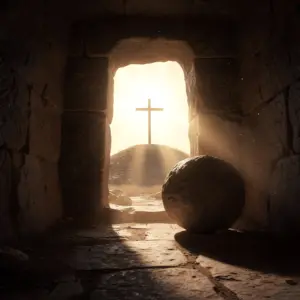
Graham insists that the resurrection is not a metaphor and demands that it is a real event in history. The tomb was empty. Christ truly rose. He appeared to His followers. And he insists it because if that did not happen, then what are we all doing here?
Graham refuses to reduce Christianity to feelings. He knows that if the resurrection is only symbolic, the Gospel is useless. Hope becomes wishful thinking. Faith becomes emotion. Salvation becomes uncertain. But since Christ truly rose, the Christian message stands on a solid foundation.
That is why Graham says the resurrection is the “primary truth” of the Christian faith. Not because it stands apart from the cross, but because it confirms and vindicates everything the cross accomplished. The resurrection is the Father’s public declaration that the Son’s sacrifice was accepted and that death has been conquered.
 Victory Over Death
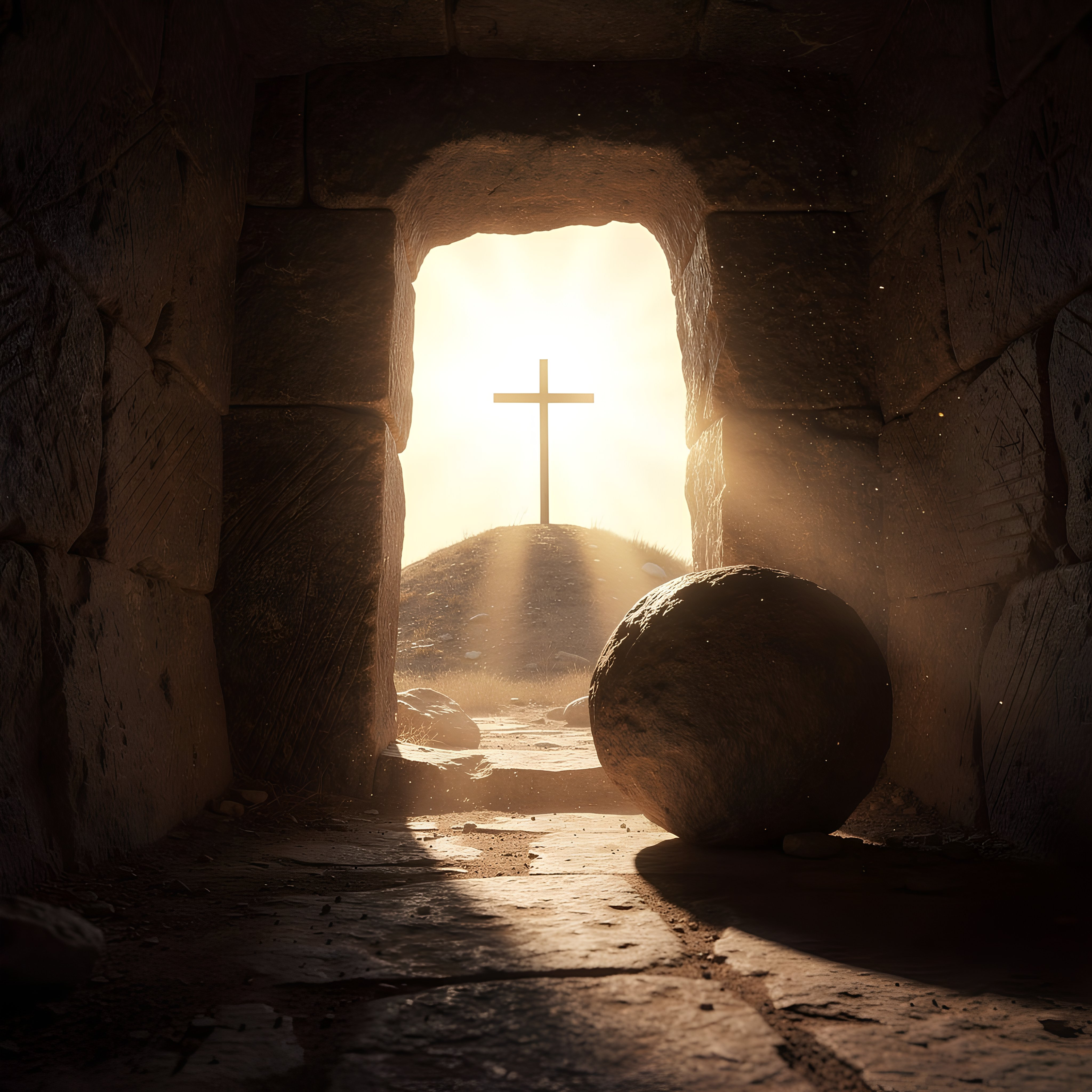
One of Graham’s most obvious themes in this message is victory over death. He connects death to sin, tracing the problem back to Adam and humanity’s fall. Death is not presented as natural in the neutral sense. It is an intruder, an enemy, an effect of sin.
That makes the resurrection all the more glorious. Christ did not merely survive death. He defeated it. He came out of the grave victorious, and in doing so He changed the meaning of the grave for all who trust Him. The tomb is no longer a final prison. It has been opened.
This part of the sermon would have resonated deeply with generations of listeners, and it still does. Human beings remain haunted by death no matter how advanced, distracted, or entertained they become. Graham does not try to soften that reality. He answers it with a risen Christ.
 Victory Over Sin

Graham also makes clear that the resurrection is not only about life after death. It is about freedom from the reign of sin now. He says the penalty of sin has been removed, the power of sin in the believer’s life has been broken, and the presence of sin will one day be taken away completely.
That is a rich and important framework. It means the Gospel is not merely about eventual escape from this world. It is about real transformation in this world. The believer is not only forgiven; he is also brought into a new life shaped by Christ’s victory.
Graham’s language here reflects a deeply biblical pattern: justification, sanctification, and glorification. He does not use those formal theological categories in the sermon, but he preaches their substance. The believer is cleared of guilt, enabled for holy living, and promised final redemption.
 Victory Over Doubt

A particularly pastoral section of the message is Graham’s discussion of doubt. He is not talking primarily about philosophical skepticism. He is talking about professing Christians who are plagued by uncertainty about forgiveness, assurance, and their standing before God.
Graham understood that many churchgoing people are deeply unsettled. They believe the right doctrines in principle, but inwardly they remain fearful and unstable. So he directs them not inward, but outward—to the empty tomb.
His argument is powerful: if Christ rose, then His promises live. His words are not hollow. His assurances are not empty religious slogans. The resurrection validates all that He said. The believer’s confidence, then, is not rooted in fluctuating feelings but in a risen Savior who keeps His word.
This is one reason Graham remained so effective. He preached to both the lost and the anxious church member in the same sermon. He could call the unbeliever to repentance while also strengthening the weak believer with the objective truth of Christ’s work.
Victory Over Fear
Closely related to doubt is fear, and Graham treats it as one of the great spiritual cripplers of human life. Fear of death. Fear of loss. Fear of public disapproval. Fear of taking a stand. Fear of consequences. He sees these fears even among Christians who know what is right but hesitate to act when obedience becomes costly.
The answer, again, is the resurrection. If Christ has conquered death, then the believer is free to live courageously. Not recklessly, and not arrogantly, but steadily. The risen Christ gives the Christian a ground for courage that circumstances cannot destroy.
This is a timely word in any age. Fear can make a person compromise, grow silent, settle for half-obedience, or retreat into private religion. Graham pushes against that. Resurrection faith is not fragile. It produces moral backbone.
Victory in Daily Living
Importantly, Graham does not confine resurrection power to a future hope alone. He insists it should be visible in the believer’s daily life. The resurrection should not merely be believed once a year on Easter Sunday. It should be manifested in ordinary life—in conduct, perseverance, witness, holiness, and confidence in God.
This is where the sermon becomes especially practical. Graham is not satisfied with doctrinal agreement. He wants transformed living. If Christ is risen, then the believer should increasingly reflect His life. Daily victory is not sinless perfection, but it is real spiritual power at work in real human weakness.
A Simpler but Stronger Kind of Apologetic
Near the end of the sermon, Graham tells the story of a meeting in Moscow where a public speaker attacked Christianity. A young man then rose and simply declared, “Christ is risen,” and the crowd responded with the traditional Easter affirmation. It is a striking illustration because it shows something important about Graham’s preaching method.
He certainly believed Christianity could answer objections, but he also believed that the Church must never become embarrassed by its central confession. The resurrection is not an optional add-on to Christianity. It is Christianity’s beating heart. In the end, Graham’s confidence was not in rhetorical cleverness but in the enduring force of the Gospel itself.
What This Sermon Reveals About Billy Graham
This Easter message shows why Billy Graham’s preaching had such unusual reach. He was doctrinal without sounding academic. He was urgent without becoming theatrical. He was simple without being shallow. Most importantly, he aimed relentlessly at the conscience.
He preached a Christianity in which God is holy, man is sinful, Christ is sufficient, and the listener must respond. That framework can feel blunt in an age that prefers ambiguity, but it is precisely why Graham’s preaching still lands with such weight. He was not trying to entertain his audience. He was trying to bring them face to face with eternity.
And that helps explain why this sermon still works as a radio feature today. It does not depend on current events, trends, or sentimentality. It speaks to permanent realities: guilt, fear, death, forgiveness, hope, and the person of Jesus Christ. Those realities do not age out.
Why “A Resurrection of Hope” Still Matters
At its core, this sermon is about hope—but not the flimsy kind people often mean when they use that word. Graham is not offering motivational optimism. He is not saying things will work out because people are good, history bends automatically toward peace, or human beings can save themselves.
The hope Graham proclaims is rooted in events: Christ died for sinners, Christ rose from the dead, and Christ now offers forgiveness and eternal life to all who will receive Him by faith. That kind of hope can face suffering because it is not built on circumstances. It can face guilt because it is not built on self-justification. And it can face death because it is not built on denial.
That is why the phrase resurrection of hope is so fitting. In Graham’s sermon, hope is not merely described; it is raised from the dead. It emerges out of the tomb with Christ Himself.
Final Thoughts
Billy Graham’s Easter message is both proclamation and invitation. It proclaims what God has done in Christ through the cross and resurrection. And it invites every listener to respond personally. Graham does not leave the sermon in the realm of abstract theology. He brings it home.
The cross means your sin can be forgiven, and the resurrection means your hope can be made alive. In a world still marked by confusion, fear, suffering, and death, that message remains as urgent as ever.