
Did Jesus Really Rise from the Dead? The Historical Case for the Resurrection
Easter is not a “sentimental” holiday. It is not merely about tradition, family gatherings, or even inspiration and it surely is not about painting eggs and surprising kids with candy in wicker vessels. At the center of Easter is a claim that stands or falls in the arena of history: that Jesus Christ was crucified, died, was buried, and rose bodily from the dead.
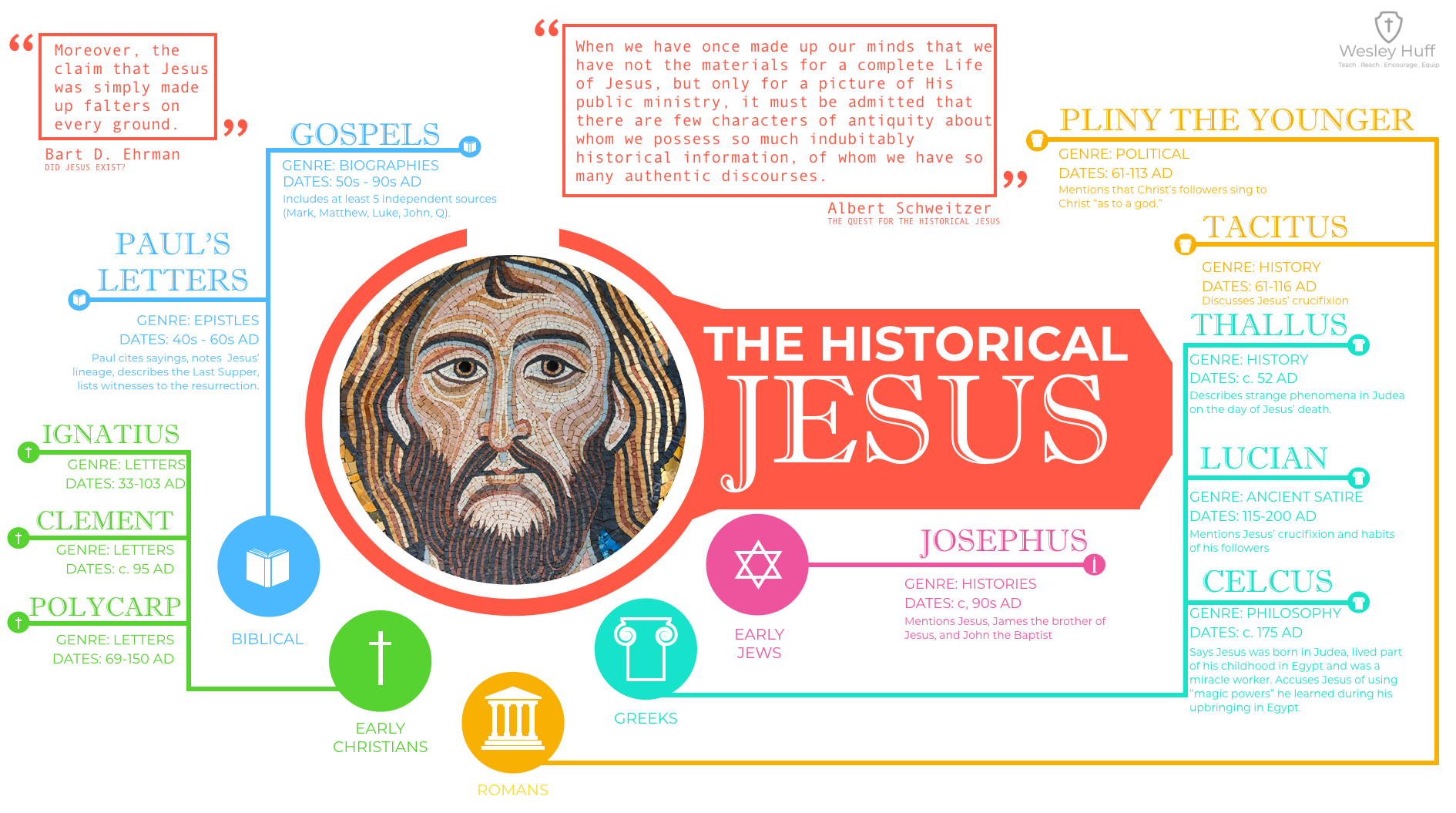
While we’re not talking about whether or not Jesus lived—but whether He rose from the dead…
It’s helpful to understand the historical reasons we know He existed. Even atheist scholars agree that Jesus was a real man who lived and taught in the Levant in the first century. Click to explore the evidence.
This is not a vague spiritual idea. It is not symbolic language. It is a claim. A claim about something that either happened or did not happen. And Christianity is uniquely vulnerable on this point by God’s design. The apostle Paul wrote that if Christ has not been raised, then the Christian faith is empty. In other words, Christianity invites investigation because it is rooted in an event.
1 Corinthians 15:14, NIV: And if Christ has not been raised, our preaching is useless and so is your faith.
For nearly two thousand years, critics have attempted to explain away the resurrection. What is striking is not how persuasive those arguments have become, but how little they have changed. The objections raised today are, in many cases, the same objections raised in the earliest centuries; repackaged for a modern audience.
For example in Matthew 28:15, we find that even the chief of the Sanhedrin bribed the soldiers to tell their boss that a Christian came and stole the body in the middle of the night:
Matt 28: 12-14: 12 When the chief priests had met with the elders and devised a plan, they gave the soldiers a large sum of money, 13 telling them, “You are to say, ‘His disciples came during the night and stole him away while we were asleep.’ 14 If this report gets to the governor, we will satisfy him and keep you out of trouble.”
A Greek writer and philosopher in the second century named Celsus wrote about the Christians’ resurrection story and how it’s not literally true, and had it not been for our church Father Origen, we wouldn’t even know it exists. After the Roman Church grew, they did try to eradicate any dissenting opinions, which isn’t a great look, but it is what it is. Celsus, via Origen, said the following (again these are faithful paraphrasings, since Origen is our only ORIGIN (😂) for those:
“The resurrection story is based on the testimony of a hysterical woman.”
“Jesus only appeared to those who already believed in him.”
“This was nothing more than a delusion or deception.”
So the question is not whether there are objections. There always have been. The real question is this: what explanation best accounts for the historical evidence? Like Lee Strobel in The Case For Christ, Christians ought to find the evidentiary reasons for our beliefs; because the so-called “New Atheists” (Sam Harris, Richard Dawkins, Christopher Hitchens, and Daniel Dennett are frequently referred to as “The 4 Horsemen of New Atheism”) use that standard, and we are called as apologists to meet our prospective evangelees where they are (1 Cor 9:19, 22, John 4:1-42, Matthew 9:9-13, Acts 17:22-31, 1 Corinthians 5:9-10, 2 Corinthians 6:14).
There are myriad examples of people in the first century all the way to today who claim that it never happened, but consider that the claims that are made are that the people hallucinated, or they were unreliable women, or that they dishonestly made it up. What you DON’T see (are you ready?) is that THE TOMB WAS EMPTY. The authorities at the time couldn’t produce a body. They couldn’t show the empirical evidence that Jesus hadn’t risen. What we DO have are over 600 eyewitness accounts from individuals who saw Him, and records of Him continuing his ministry for 40 days after His own death. That’ll PREACH!
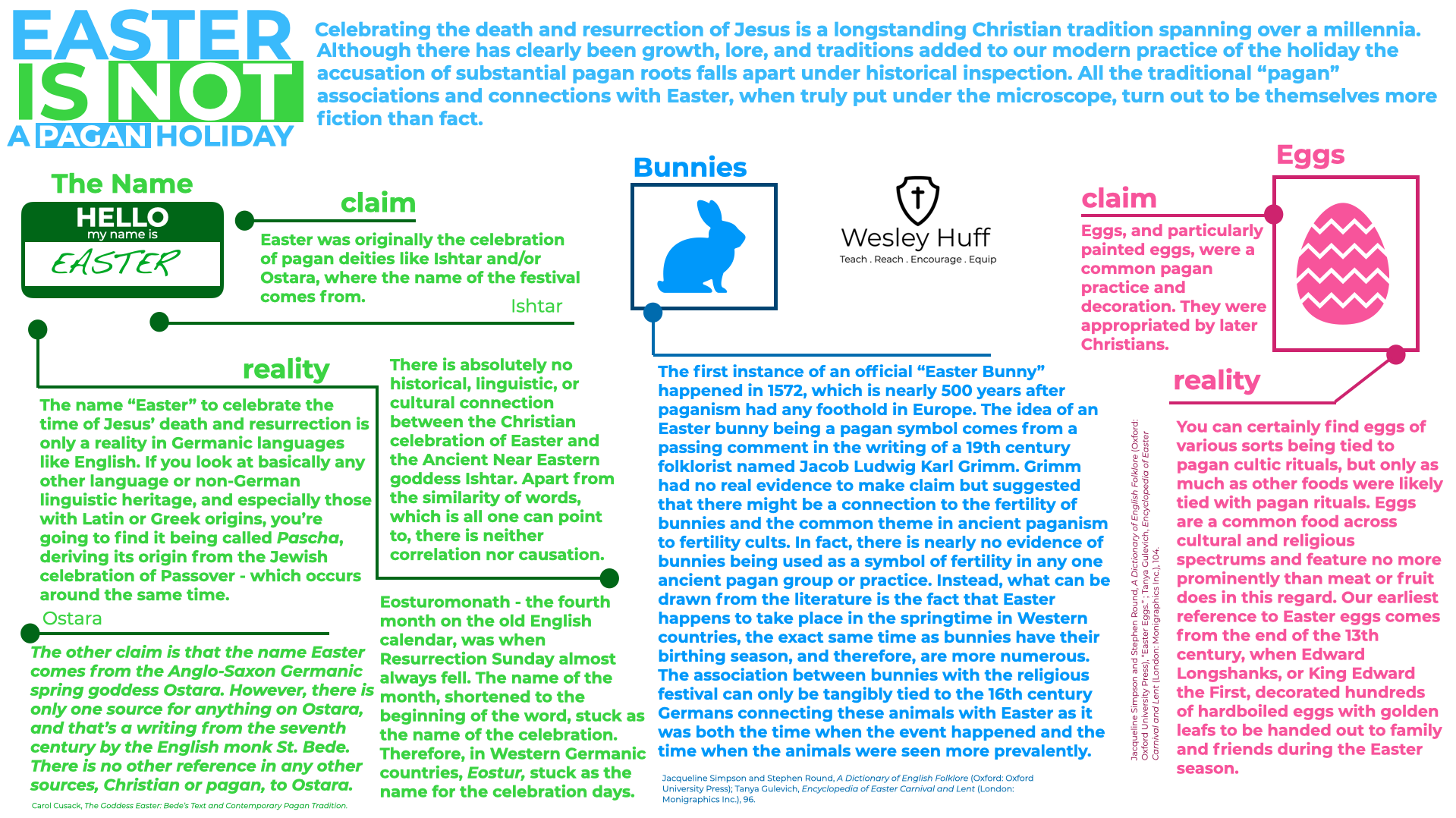
Many people today mistakenly argue that Easter is some sort of a shoplifted version of a pagan ceremony or celebration. The argument is convincing, even comparing it to the similar names “Ishtar”, or “Ostara” pagan goddesses. There is ZERO evidence that the two are connected—and this infographic makes that clear. In fact, it only shares that similarity in Germanic languages, Latin and Greek languages call it “Pascha” (Passover)
Early Critics Did Not Ignore the Resurrection, They Tried to Explain It
One of the most overlooked facts in this discussion is that the earliest opponents of Christianity did not deny the central claims outright. They responded to them. That matters a lot, and it means the resurrection was being proclaimed so forcefully and so early that it demanded an answer.
First Century Objection: “The Disciples Stole the Body”
The earliest recorded counter-argument, coming from the Jewish context in the first century, was that the disciples stole the body of Jesus from the tomb.
Notice what this argument assumes. It does not argue that Jesus remained in the grave. It does not produce a body. It does not claim the tomb was occupied. Instead, it concedes the key point: the tomb was empty. The debate begins not with whether the tomb was empty, but with how to explain why it was empty.
This is important. From the very beginning, critics were forced into explanatory theories rather than simple denial.
Second Century Criticism: Philosophical and Psychological Attacks
By the second century, criticism of Christianity had become more developed. Celsus, a Greek philosopher, wrote one of the earliest sustained attacks on the Christian faith. He argued that the resurrection accounts were unreliable and suggested that the experiences of Jesus’ followers could be explained as delusions or wishful thinking.
Here we see the early form of what is now called the “hallucination theory.” It is often presented today as a modern psychological insight, but it is, in fact, ancient. Celsus was already advancing similar ideas nearly 1,800 years ago.
His criticism also included attacks on the credibility of the witnesses. He mocked the fact that some of the first reports came from women, assuming that this weakened the case. Ironically, that detail now strengthens the case for authenticity, since it is exactly the kind of detail that would not be invented in that cultural context.
Third Century Criticism: Attacking the Text Itself
By the third century, critics such as Porphyry focused more heavily on the reliability of the biblical texts. He argued that inconsistencies or differences in the Gospel accounts undermined their credibility.
This line of reasoning is still common today. But it rests on a misunderstanding of how eyewitness testimony works. Independent accounts of the same event often differ in detail, emphasis, and sequence. That is not a weakness; it is what we expect when multiple witnesses describe a real event from different perspectives. In fact, when an investigator talks to several witnesses whose stories are nearly the same, that creates a suspicion that needs to be investigated itself. That is called “Co-witness contamination” or sometimes is indicative of collaboration.
Here’s a copy of Lee Strobel’s book The Case For Christ (internet archive is not owned or operated by KLTT Radio) that examines how that works in detail, I highly recommend reading that. If you want the Cliffs Notes, check below for a teaching sermon where he explains that concept.
At any rate, perfect uniformity would be far more suspicious, suggesting coordination or fabrication rather than authenticity.
By the end of the third century, the major categories of objection were already in place: the body was taken, the witnesses were mistaken, or the documents are unreliable. Those categories have never really disappeared.
Modern Skepticism: The Same Arguments, Rebranded
Fast forward to the modern era, and the same objections appear again, often with more confidence but not necessarily with more substance. Actually, “confidence” is being very kind, the self-proclaimed “4 Horsemen of New Atheism” aren’t as much confident as they are egotistical and haughty. “Pride goeth before destruction; a haughty spirit before the fall”.
[youtube https://www.youtube.com/watch?v=9MsgImiQIc4?si=IsfMh1sWOSBymuEd&start=263&w=768&h=455]
Writers and “free thinkers” such as Richard Dawkins and Christopher Hitchens have popularized a form of skepticism that dismisses the resurrection as myth or superstition. But when their arguments are examined closely, they typically fall into familiar patterns that are easily overcome.
Objection 1: “Miracles Are Impossible”
This is perhaps the most fundamental objection. It is often assumed, rather than argued, that miracles cannot occur because they violate the laws of nature.
But this isn’t a historical conclusion, it is a philosophical starting point. If one begins by assuming that God does not exist or does not act in the world, then any claim of resurrection will be rejected by default; regardless of the evidence. That is the aim of the modern atheist; to create a straw man of christianity, that can more easily be dethroned.
The real question is not whether miracles fit within a closed natural system. The question is whether there is good reason to believe that God exists and could act in history. If God exists, then miracles are not only possible; they are expected at key moments of revelation.
Have you ever experienced a miracle? Something that was supernatural (or: existing outside the natural laws of our earth)? We live in a culture that sensationalizes near death experiences, UAP phenomenon, and miracles are so abundant that they seem less miraculous. That, combined with the modern skepticism that pseudo-scientist shallow though masters like Richard Dawkins and Christopher Hitchens have promulgated have created a world where we don’t even see the miracles that happen in front of us every day.
[youtube https://www.youtube.com/watch?v=zQ13ohFw8l0?si=Shsy-wI9rMy8d3hD&w=768&h=455]
Objection 2: “The Gospels Are Contradictory”
Another common claim is that differences in the Gospel accounts discredit them. But this objection misunderstands the nature of historical testimony. For example, Matthew traces Jesus’ genealogy back to Abraham, but Juke goes back to Adam. Or, in the Synoptic Gospels (Mark, Matt, Luke), Jesus eats the Passover meal before his death, while in John, Jesus dies at the time the Passover lambs are being sacrificed. Also, Matthew and Mark record the demons being cast out of one man, while Matthew specifies there were two in certain instances. These differences don’t change the overall story, lessons, or facts of the accounts, they are just background details; nonetheless atheists attempt to use this as an example of the unreliability.
But the truth is, as any professional investigator will tell you, if four witnesses describe the same event with identical wording and identical detail, we would suspect collaboration like we said above. Real testimony contains variation. What matters is whether the accounts agree on the central facts—and they do: Jesus died, was buried, the tomb was empty, and He was seen alive afterward. When people recall a traffic accident, for example, investigators expect some details to be different: the driver was wearing a blue shirt not a red one, or the car was a Honda, not a Toyota. If too many things are identical, it’s suspect because when something traumatic or jarring happens, shock changes our recall. Here’s a great video from an organization called Cold-Case Christianity – these are police officers and professional investigators who help us investigate the Gospels.
[youtube https://www.youtube.com/watch?v=NPoQIVi4T1k?si=Yc5T9BnN1etUJzQQ&w=768&h=455]
Objection 3: “The Disciples Hallucinated”
Modern psychology is often invoked to explain the resurrection as a series of hallucinations or grief-induced experiences. But this explanation fails on multiple levels.
- Hallucinations are typically individual, not group experiences. There are zero examples of this. ✅
- They do not account for the empty tomb. ✅
- They do not explain repeated appearances over time. ✅
- They do not explain the conversion of skeptics like Paul. ✅
Most importantly, hallucinations do not generate a sustained public movement centered on the claim that a specific individual has physically risen from the dead. Frank Turek from CrosseXamined adeptly debunks this “Mass Hallucination Theory” in the video below:
[youtube https://www.youtube.com/watch?v=zGHKZlnf8LI?si=lcN4NmFcAOU0lk9w&w=768&h=455]
What is presented as a modern scientific explanation often fails to explain the full scope of the evidence.
Modern Apologetics Still Matters
In a culture infatuated with short-form videos like TikTok and Instagram, and confident dismissals of Christianity, careful apologetics plays an important role. Voices like Wesley Huff have helped reintroduce a serious, evidence-based approach to the reliability of the New Testament and the historical case for the resurrection.
Rather than asking people to believe blindly, Huff and others engage the actual data: manuscript evidence, early creeds, historical context, and the strength of competing explanations. This is important because many objections to Christianity are not the result of deep investigation, but of assumptions repeated often enough to feel true.
When examined carefully, the New Testament stands up remarkably well as a collection of ancient historical documents. And when those documents are taken seriously, they point consistently to the same conclusion: the earliest Christians believed, proclaimed, and were transformed by the conviction that Jesus had risen from the dead.
The Positive Case: What Evidence Actually Shows
It is not enough to answer objections. The resurrection must be considered on its own terms. When historians—both Christian and non-Christian—examine the available evidence, there are several core facts that are widely recognized.
1. Jesus Was Crucified and Died
Roman crucifixion was a brutal and efficient form of execution. It was designed to ensure death. Historical sources, including non-Christian references, confirm that Jesus lived in Judea and was executed. The idea that He merely survived is not taken seriously in modern scholarship.
Answers in Genesis answers the question well here.
2. Jesus Was Buried i a location that was known at the time
The burial of Jesus establishes a specific location where His body was placed. This is essential, because it makes the claim of an empty tomb testable in its original context.
Since then the tomb in which he was buried has been lost to time, but several peopl ehave ideas of where it is; In fact, archaeologists are hard at work to figure out that location, with some like Bob Cornuke saying they’ve figured it out! Below is a neat documentary that Bob put together, I think you’ll enjoy, it’s only 25 or so minutes:
[youtube https://www.youtube.com/watch?v=0xFXOSRfHGg?si=YAlSRHhuU-ciB9lQ&w=560&h=315]
Currently the Church of the Holy Sepulchre in Jerusalem claims to be the place of Jesus’ tomb, but that’s unlikely.
3. The Tomb Was Empty
The empty tomb is one of the central data points in this discussion. No competing theory successfully explains why the body was never produced. Even early opponents acknowledged the absence of the body and attempted to explain it.
4. Multiple Individuals and Groups Claimed to See Jesus Alive
The resurrection accounts include appearances to individuals and to groups, at least 500 individuals over the 40 days after Jesus’ death, in different settings and at different times. These were not vague impressions but claimed encounters with a living person.
5. The Disciples Were Transformed
The shift in the disciples from fear to bold proclamation demands explanation. Something changed them, and that change was directly tied to their belief that they had seen the risen Christ. One of the indicators that the disciples were legit comes from Lee Strobel’s book The Case For Christ, that the disciples traveled the earth and met their demise for Jesus; if the whole thing were a scam, they would not have volunteered – No one dies for a cause that they KNOW is a lie.
6. The Resurrection Message Appeared Immediately
The resurrection was not a legend that developed over centuries. It appears at the very beginning of the Christian movement. Early creeds and proclamations show that this belief was central from the start. Nero’s rabid attempts to eradicate it lead one to believe the Romans knew it too. Church fathers were writing about it even as John the apostle was exiled to Patmos, and near the end of the first century, Origen had already written extensively about Jesus.
7. Skeptics Became Believers
Figures like James and Paul were not predisposed to believe. Their conversion points to experiences they believed were real and compelling enough to overturn their previous positions. Paul was violently opposed to Jesus, waging campaigns to kill his believers until he met him on the road to Damascus. In fact, the author of this article was even at one time a skeptic, and I can assure you that it took very honest truths for me to turn around and see that Christ was real.
8. The Inclusion of Women as First Witnesses
This detail strongly suggests authenticity. It is unlikely to be invented given the cultural context, yet it is consistently reported. Women in first century Judea were not considered reliable, and their testimony would certainly have been disregarded. If one was inventing the scenario they absolutely unequivocally would not have delivered the news via a woman.
9. No Alternative Explanation Accounts for All the Facts
Each competing theory explains part of the evidence but fails elsewhere. Only the resurrection accounts for the empty tomb, the appearances, the transformation of the disciples, and the rapid rise of the early Church.
Jesus’ body was stolen from the tomb – This is the one that was claimed in the first century, but that leaves a lot to be desired. First the Roman guards were watching the tomb on threat of death; if the body was stolen they would have been killed. Then there was the wax seal the Romans placed on the tomb, and the several-ton stone sealed by the Romans that they’d have to get past. Not going to happen. And if the body was stolen by the disciples, why would they die to keep that lie?
Hallucination Theory – This theory claims that the disciples and 500 other people in the book of Acts hallucinated seeing jesus after the fact — That’s just silly, that many people have never and will never hallucinate exactly the same thing.
Legend/Myth theory – This claim is that the story of Jesus changed over time, as a legend grows. This claims that over time the story was embellished; but again, why would the disciples have died, some brutally (Peter was crucified upside-down by his own choice!) for something that they knew was a lie? It also doesn’t explain the extra-biblical stories of the things that happened, such as Phlegon of Trelles 2nd Century account of the earthquake and eclipse that was recorded. Geologists have identified an earthquake in the region dating back to around 31AD, give or take 5 years, although no exact date could be given from the data. The point is, the things in scripture happened, and if we don’t accept them then we can’t accept things like Caesar crossing the rubicon, anything Plato or Socrates wrote, or Alexander the Great!
SWOON theory – This theory is a BIG TIME stretch; it states that the Roman guards never actually killed Jesus; that he was up and walking three days later, after “swooning”. If you recall the story of the crucifixion, that is absurd. This also hinges ironically on the fact that the Romans did not break jesus’ legs (ironic because they didn’t break his legs because He was so dead that there was no question He wasn’t going anywhere) and some say that when they pierced our savior’s side that some magic bb hit his organs causing him to live through it. That is lunacy.
“Shallow grave” tomb – As long as they’re just making things up, there are a scant few folks who believe that rather than being put into a tomb, Jesus was actually buried in a shallow grave and came out like a zombie. This one I don’t think we need to explain at all, it’s pretty out there.
10. The Resurrection Is the Best Explanation
When all the evidence is considered together, the resurrection is not a blind leap of faith. It is the logical conclusion that best fits the available data, both eyewitness evidence and logical conclusions.
The Bottom Line
The resurrection is not merely a debate topic, it is a historical event that has mountains of evidence for it. It also makes or breaks Christianity, according to Paul.
If Jesus did not rise from the dead, then Christianity is false. It should be rejected. But if He did rise, then He is who He claimed to be. He is Lord. He has authority over life and death. And His claims demand a response.
Easter confronts us with a question that cannot be ignored: what will you do with Jesus Christ?
For two thousand years, critics have challenged the resurrection. The arguments have come and gone, and the names have changed; the tone has shifted, but the central claim remains and has remained for nearly 2,000 years:
The tomb was empty.
Jesus was seen alive.
And the movement that began in Jerusalem has never stopped.
He is risen.
TL:DR; In case this post was too long, and you just want to JUMP RIGHT IN to the veracity of the resurrection and the rest of scripture with interactive resources, videos and articles, start right here! 👇
APOLOGETICS PORTAL
Strengthen your understanding of the Christian faith with trusted resources, historical evidence, and answers to common objections.

Start Here
- New to apologetics? Begin with The Case for Christ by Lee Strobel – READ IT ONLINE HERE or purchase it HERE
- Quick answers? Use GotQuestions.org for quick answers to thousands of questions – FIND THEM HERE
- Deep dive? Explore Cross Examined, where legendary apologeticist, and Charlie Kirk’s mentor in faith Frankt Turek – FIND THEM HERE
- Visual learner? Check out these AMAZING apologetics infographics that Wes Huff has built – REVIEW AND DOWNLOAD THEM HERE
Wesley Huff
Clear, evidence-based teaching on the reliability of Scripture and the historical case for Christianity.
Infographics
Visual tools to debunk common misconceptions about Christianity and the Bible.
The Case for Christ
An investigative look at the evidence for Jesus by Lee Strobel, former writer for the Chicago Tribune
Got Questions?
Quick, clear answers to thousands of real-world questions about the Bible and Christianity.
Bible Reliability
Explore how the New Testament was preserved through thousands of early manuscripts and careful transmission.
Take It With You
Scan to access the Cross Examined app from Frank Turek’s team, and keep apologetics tools right in your pocket. You’ll find an easy, simple interface with debate tactics, logical fallacies, and answers to questions and claims like “Didn’t Jesus say not to judge?” or “There is no truth!”