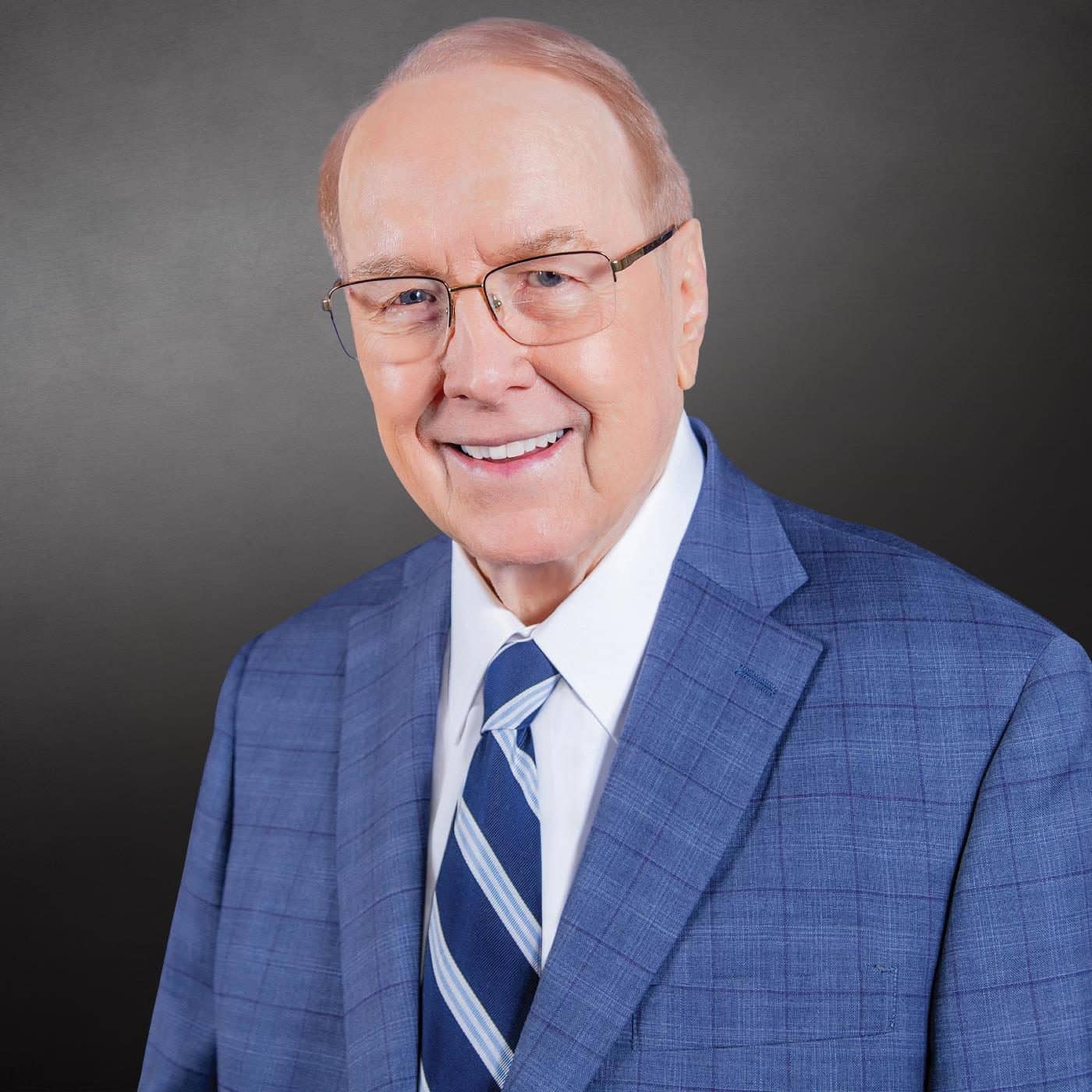

This episode of Family Talk, we deeply honor the late Dr. James Dobson, with cherished recollections shared by his friend and fellow broadcaster, Chris Fabry. From personal reflections to professional milestones, step into the conversations that reveal Dr. Dobson’s enduring impact on millions. Listen as Roger Marsh brings us a heartwarming tribute, encompassing his life’s work, memorable experiences, and invaluable wisdom that continues to guide us forward.
SPEAKER 03 :
Hello, everyone. You’re listening to Family Talk, a radio broadcasting ministry of the James Dobson Family Institute. I’m Dr. James Dobson, and thank you for joining us for this program.
SPEAKER 01 :
Well, welcome to Family Talk, the broadcast division of the Dr. James Dobson Family Institute. I’m Roger Marsh. It was just last Thursday, very early in the morning of August 21st, that our beloved founder of the James Dobson Family Institute, Dr. James C. Dobson Jr., passed into the presence of his Lord and Savior, Jesus Christ. Because his health was failing, we all knew the day was imminent, but I can speak for the loyal team that Dr. Dobson gathered here in Colorado Springs, and perhaps millions of grateful listeners all around the world just like you. We’ve been overcome with emotion. Yes, Dr. Dobson did receive his ultimate healing, and for that, we are very grateful. But at the same time, his absence creates a huge void. In times like these, when the emotions are still very, very fresh, We knew you’d enjoy hearing one of the most transparent conversations Dr. Dobson ever recorded as part of our collection of special recordings that we will be featuring all this week. Chris Fabry is a nationally known radio host with Moody Radio. He’s hosted Chris Fabry Live since 2008. He was one of Dr. Dobson’s very close friends, especially in the broadcast world. They worked together on writing projects. Chris was a regular guest here on Dr. James Dobson’s Family Talk. And on the next two days here on Family Talk, we have the delight of recounting a conversation that they had on Chris Fabry Live. So let’s listen in now as Chris Fabry begins today’s recollection as we remember the life of Dr. James Dobson here on this edition of Family Talk.
SPEAKER 02 :
One of the first guests I remember inviting onto this program when we began back in May of 2008 was Dr. James Dobson. He needs no introduction, really. And every time I hear people say that, they give a lengthy introduction. But if he needs no introduction, why give one? From his studio in Colorado, where he conducts Dr. James Dobson’s family talk. Dr. James Dobson, how in the world are you?
SPEAKER 03 :
I’m doing great, Chris, and I love you like a brother. It’s a real pleasure to be able to talk to you today.
SPEAKER 02 :
Same here. Now, I’ve got some questions to ask you. First, you were the first person who told me the upsides of throat coat tea and using yellow legal pads. Are those still on the table there in front of you? I don’t even know what throat coat…
SPEAKER 03 :
Tea is. That went the way of all flesh. I do find it helpful when my voice is scratchy, and it does get that way every now and then, to gargle with salt. I don’t know what that does, but it does help. And there are also some other kinds of… throat lozenges and so on that help. I’ve been at this for 40 years and I never know exactly what I’m going to get when I open my mouth. Yeah.
SPEAKER 02 :
You know, here’s the other thing. I find that time has accelerated in my own life and the way that I look at things. And you turn around and that week’s gone, that month’s gone, a year or ten are gone. Has time accelerated for you the same way?
SPEAKER 03 :
You know, when I was a kid, I was told that the older you get, the faster time moves. And I’m telling you, it is absolutely true. I didn’t believe it then. I sure do now. It’s just amazing how fast it goes. And I’m enjoying every minute of it. I hope you are. But I sometimes wish that I could slow it down a little bit.
SPEAKER 02 :
Well, one of the reasons why you got into radio was that whole thing. You were going around the country and speaking and doing video seminars, that kind of thing. And you really could see your family kind of slipping away or connection with your family. Is that why you got into radio?
SPEAKER 03 :
Well, honestly, there are several things that had an influence on me, but that was probably at the top of the list because my daughter was 13. My son was, I think, eight. They were both headed straight for adolescence, and I was – feeling the need to be with them and not let those years get away from me. And I was doing far too much traveling. And finally, I just said to Shirley, you know, I don’t think that we’re given our kids the amount of time we ought to. I never really did fail to go places and do things. I started hunting with Ryan very early, and I thought radio was a good way to get a message across and stay at home, and it turned out to be exactly that. But there are other things. I saw the institution, the family, falling apart. And I really just felt that I ought to do what I could to try to make a contribution. But let me tell you one other thing. I don’t want to filibuster here, but there’s something I don’t think I’ve ever told you or anybody else. Shirley and I frequently went to London in those days, and the publishers paid the bill for it for both of us. And so I wrote a number of my books there and in Scotland and in Australia and other places. And I got really interested in the BBC. And they had all kinds of various things that they talked about. And that really looked good to me. I thought that the most Christian radio that I saw was Sunday morning sermons. And there’s nothing wrong with that. I’m just not a minister, and that’s not exactly what I came to do. Instead, we talked about a wide variety of things in the model of the BBC. And so that had a big influence on me, too.
SPEAKER 02 :
Well, and the content of the BBC as well. And you listening to that probably made you think, why can’t we do something along those same lines to engage people at the heart level? Because you don’t have to have the pictures, the video that’s going on to cloud things. It’s just you, your voice and that other person, right? Yeah.
SPEAKER 03 :
Yeah, let me tell you one other thing that I don’t know if I’ve talked about publicly a lot. I had an opportunity to do television and radio at one time when I left Children’s Hospital in USC School of Medicine. And I wasn’t sure which one I should do. People were providing money for television. And so I just called my dad. Always when I had a question like that, I called my dad. And I said, Dad, I’ve got an opportunity to do both radio and television. And what do you think I ought to do? Would you pray about that? He said, I will pray about that. And you can bet he did. And about four days later, we were talking on the telephone. And I’d kind of forgotten the question. He said, by the way, I’ve been praying about what you asked me about. And I said, well, what conclusion did you draw? And he said, it’s radio. He said, I really think you can accomplish a whole lot more with less of your time and energy and less money and all that television. It just absorbs every energy.
SPEAKER 02 :
He said, I think it’s radio. His influence was so strong in your life. Just like my own father, when he talked and he wanted to get his point across, he would put both hands out there and he would move his hands. Your hands are very important to every broadcast you do. Is that true?
SPEAKER 03 :
You know, I’m not aware of it, but as you mentioned it, yes, I do move my hands and The interesting thing about radio is that people are very influenced by the nature of your voice. It is really interesting to me that some people, their voice is not attractive to them. And they probably ought to be doing something else. And I find that for some reason, people like my voice. And they feel comforted by it. All I know is what they tell me. And my voice is a little scratchy today, so it’s probably not a good time to say I’ve got some great gift here. But there is something about a voice that is either warm and comforting or sometimes it’s irritating. And a whole lot in radio depends on the sound of the voice.
SPEAKER 02 :
Yeah, I agree. And I think part of it is, too, you know, I mean, you’ve got these graduate degrees. You are learned. But you didn’t lose the Louisiana part of you. And even when you say the word perspective, it comes out perspective. And, you know, it’s the E.V., And I know that you could have changed that. You could have enunciated and cleaned up everything. But that’s part of where you come from. That’s part of your stock, isn’t it?
SPEAKER 03 :
Well, yes. But I left Louisiana when I was, I think, 10 months old. So I didn’t spend a lot of time there, although I have relatives there. But I spent a lot of time in Texas, in Oklahoma. And I spent the first grade in Arkansas, Texas. And then a big mix of California. And you put it all in there. People can’t figure out who it is or what it is they’re listening to. It’s really interesting to me that a lot of comedians have tried to mimic my voice. And that’s not a one of them that gets it. Maybe they think they do. But I don’t think it sounds like me at all. Because I’ve got a mix of all kinds of junk in there. And so it’s just not easy to identify.
SPEAKER 02 :
But not only your voice, then there’s a warmth. There is a power there. There’s an invitation that the warmth that the voice gives. But there’s also an importance of the content. There’s a message that you have had through the years that has stayed really on point. And I think that’s another reason why people have gravitated toward you. Talk a little bit about that for the last 40 years, the power of your message.
SPEAKER 03 :
Well, I think my message hasn’t changed because it came again from what I heard at home and what I saw and what I believed. The message is a product of my love for the Lord and what I felt he called me to do. And I just have not seen any reason to veer away from it very much. My dad did have a great influence on me in all of my early life. My mother did too. Both of them were powerful people. They both loved the Lord. You know that I have said this on the air, that I learned to pray before I learned to talk. And the reason for that is that my parents had devotions every day, and they prayed a lot. And I began imitating the sounds of prayer before I knew the meaning of the words. And I just grew up with that. And so I have not sat down and tried to craft a message that was somehow out of the blue. I was really reporting what I had heard and what I believed and my relationship with Jesus Christ. I was four years old when I gave my heart to the Lord. Hey, can I tell you a funny story?
SPEAKER 02 :
Yeah, thank you.
SPEAKER 03 :
My daughter went through about 20 boxes of memorabilia that I have kept since I was in college. And she found all kinds of stuff in there. And one of them was a letter that my mother wrote to my dad. Shortly after I had given my heart to the Lord, I went to an actual altar and I knelt there and I wept and I gave my heart to Jesus. And my dad came down off the platform and put his arm around me and prayed for me. And I took that really seriously. I mean, that made a great impact on me. People may think that a four-year-old can’t really identify in that way. But I’m telling you, I did. And it was the most significant moment of my life and has stayed with me. But shortly thereafter, I was riding my tricycle. And this is what my mother wrote to my dad, that I was riding along and I slipped and I fell and I really hurt my hand. And I was wailing over this. I mean, I was really hurt. And my mother said, well, Jimmy, why don’t you pray about it? And I thought that was a pretty good idea. So I started praying about it. And then I stopped praying and went back to crying. And my mother said, well, what did Jesus say to you? And I said, he told me he was busy watering the trees and the flowers and he’d get to me when he could.
SPEAKER 04 :
That is a literal interpretation of prayer, I think. Yes, it is.
SPEAKER 02 :
Four years old. Here’s the other thing. When you bring that up, it is your memory. I don’t know if you still have the same memory as a few years ago when I worked with you. But you would stop in the middle of, you know, recording a program and say, you know, we had so and so on that program three months ago. And she said this or three years ago or remember in 1970, whatever. How do you explain your ability to recall?
SPEAKER 03 :
You know, I’ve thought a lot about that because my field is child development, and I’m really interested in learning and how that takes place. There are people who have good memory because they recall the outcome of events, and they remember being with somebody or what have you. I think my memory and a lot of other people’s memory is intense because I actually have it videotaped. In other words, when I’m telling you I remember something, I’m not just talking about a memory of a memory. I’m talking about a moment when I was in a certain place and with a certain person, and I can almost hear them say the words. My daughter is even better at that than I am. She is scary in what she remembers. I sometimes wish that she didn’t remember absolutely everything that happened as a child, but she does. And I think it’s because of that matter of the difference between a memory of a memory and a memory that is real. vividly videoed in your mind. And that is something that I enjoy. I do have a good memory.
SPEAKER 02 :
The people who work with you, the engineers, the engineers used to tell me, you know, if he says something like this, what we have learned is 99% of the time, he’s usually right. So just go with him, whatever he said about it, because, you know, there will be times now that didn’t happen that way. And they just figured, you know what? He usually is right because he’s got this memory thing going.
SPEAKER 03 :
Well, that’s been very helpful to me because a lot of my speaking and radio work is really a compilation of stories. I like to tell stories and I tell them because I remember them. I’ve got maybe 100 memories in my second year, and I know where I was and what I was doing. One time I was playing with rocks in a driveway, and I don’t know why that stuck with me, but we’ve got a photograph of it, and I was about two years of age. I really have had the opportunity to pull up stories and tell people, and they’re not made up. I’m telling you, if I can see it in my head, then I know it happened.
SPEAKER 02 :
I wonder if you remember this. It was my worst moment with you, and we were in the middle studio at Focus on the Family when you were there, and you had come down to do a recording, and it was during the NCAA tournament. you had recorded to watch later on, and you said, don’t anybody tell me who had won the game. And as I was walking out of the studio, you said something like, that team, I think they’re going to go all the way. And I said something like, well, such and such a team can beat them. And that tipped you off as to who won that game that you had recorded. And so I messed up your whole… You did. Yes, sir. I do remember that. Yeah, that’s the worst thing you can do for me. I felt so bad. I felt so bad about that. All right, so in your 40 years of radio, do you have a most emotional moment? Did you ever have to stop the recording, or did you always just keep going with the recording when you had emotion happen?
SPEAKER 03 :
Oh, no. Emotion is very important. And it’s not only important to radio, but it’s important to let it happen when it occurs. You can’t manufacture it. And that becomes phony and people can smell that. And that’s not what I’m talking about. But when there is a moment, you let it go. A Let me tell you an example of that. We had a guest on Focus on the Family in 1983. And she was pregnant and didn’t know it. And she suddenly realized that she had been carrying this baby and had not welcomed him into her life. And she began crying. And I’m telling you, it was right at the start of the abortion movement and how people felt about bringing the babies into the world. And both of us began weeping. I’m telling you, I could not stop. And she was also weeping. We still have that tape. And she was trying to tell us that she was afraid that baby would not feel welcomed and secure and brought into the life of that family. I’ve had a lot of moments like that. But what I was going to tell you is that the editor cut that entire sequence out and it fell on the floor and was lost. And he thought, well, you know, so you’re crying. I mean… You don’t need that. You’re just wasting time. You’re not even talking. And I teased him for years about that because I considered that one of the most important moments in the year. Because we were really experiencing something that I felt like the audience not only identified with, but also wept with us.
SPEAKER 02 :
Yes. And right there is part of the reason why, again, your voice, the content, but also you’re not afraid of emotion. Right. And if you shrink back from that, you’re also not afraid to laugh. And that’s the other thing that you told them not to cut out. If we’re laughing and if we’re going that way, you know, don’t cut that out because that’s what will draw people in, right? People like to feel.
SPEAKER 03 :
You know, they like to feel so much of what they hear, maybe sometime in church or in other radio programs or what have you. And there’s nothing to feel there that people don’t cry, but they don’t laugh either. And I think we all need to laugh. We need to enjoy the experience as we go through life. And so when something really funny happens, don’t you dare cut that out. But don’t try to laugh over something that’s not funny because that will turn people off big time.
SPEAKER 01 :
Well, I must confess that I’m fighting back a bit of emotion here as I revisit this conversation with you here on today’s edition of Dr. James Dobson’s Family Talk, featuring our founder and chairman, the late Dr. James C. Dobson, and his good friend and colleague in broadcasting, Chris Fabry. This was an edition of Chris Fabry Live from several years ago. Today here on Dr. James Dobson’s Family Talk, if you did join our program a the announcement that Dr. Dobson did pass into the presence of his Lord and Savior that he served so passionately just before sunrise on Thursday, August the 21st. This week at Family Talk, we’ve set aside today’s and tomorrow’s programs to enjoy all of Dr. Dobson’s conversation with Chris Fabry. And of course, in the event that you missed any part of this dialogue, You can listen again online at drjamesdobson.org. When you go to drjamesdobson.org, of course, you’ll find that our website has been completely transformed into a memorial for Dr. Dobson. And if you would like to share your thoughts and your recollections on how the ministry of Family Talk impacted your life, you can do so right there. You know, since 1977, Dr. James C. Dobson provided hope and wisdom for families everywhere. His credentials as a family expert were valued by millions all over the world. As a loyal husband and loving father to his children, Brian and Danae, Dr. Dobson had a masterful way of communicating biblical wisdom through personal anecdotes. And whether visiting the president in the White House, which he did very often, five different presidents in all, or sharing stories on his broadcast. Dr. Dobson was comfortable in either and both settings. In this fresh season of celebrating Dr. Dobson’s graduation to heaven, we would love to hear from you. Now, this coming Wednesday, August 27th, would have been Dr. Dobson and his wife Shirley’s 65th wedding anniversary. And to commemorate that special event, we have a special two-part program that we put together as a commemorative CD called The Dobsons, A Marriage Made in Heaven. We’ll be happy to send you a copy of that special commemorative CD as our way of thanking you for your gift of any amount in support of the Dr. James Dobson Family Institute today. You know, in a real sense, it is our turn now. to grasp the baton that Dr. Dobson has passed to us and to carry this timeless ministry into the future. You can do so right now when you make a secure donation online at drjamesdobson.org. If you’d prefer, you can send a check through the mail along with a personal note of reflection as well. You can address your envelope to Dr. James Dobson’s Family Talk, P.O. Box 39000, Colorado Springs, Colorado, 80949. Of course, you can always pick up the phone and speak with a member of our friendly customer constituent care team when you call 877-732-6825. Well, I’m Roger Marsh, inviting you to join us again tomorrow as we continue to celebrate the life and legacy of the late Dr. James C. Dobson. We’ll hear part two of his conversation with author and commentator Chris Fabry. That’s coming up on Tuesday’s edition of Dr. James Dobson’s Family Talk, the voice you can still trust for the family you love. This has been a presentation of the Dr. James Dobson Family Institute.