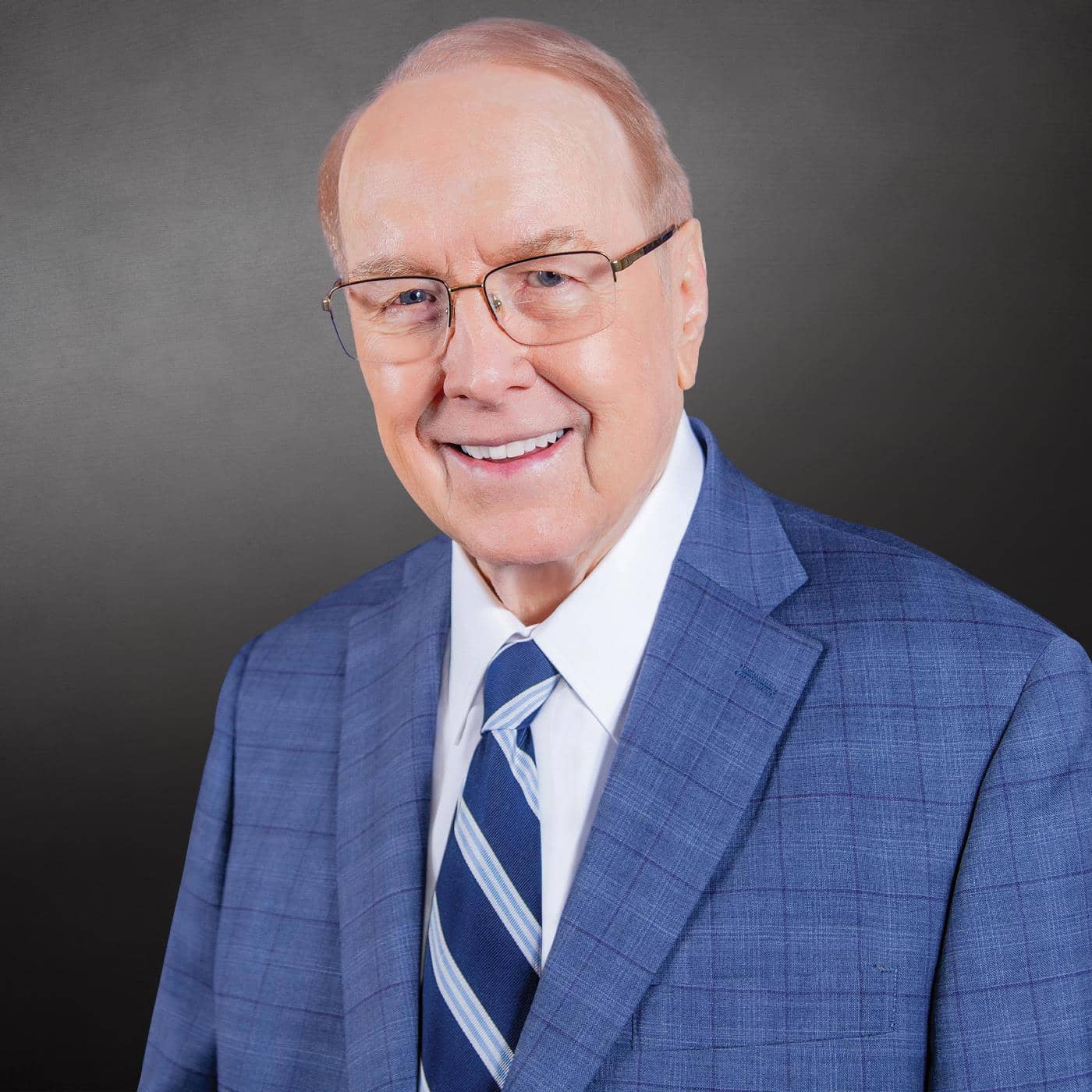


According to Dr. Robert Lewis, who is the pastor, author and founder of the original Men’s Fraternity, We have lost the ability to pass on to the next generation a vision of manhood that makes sense and is compelling to young men. On today’s edition of Family Talk, Dr. James Dobson and Pastor Lewis discuss the essentials of what it means to be a man, and why the inability of dads to connect with their sons can cause a huge loss of their masculine identity. Discover more as Dr. Lewis defines the different phases of training up boys, and
Welcome everyone to Family Talk. It’s a ministry of the James Dobson Family Institute supported by listeners just like you. I’m Dr. James Dobson, and I’m thrilled that you’ve joined us.
Well, welcome to Family Talk, the broadcast division of the Dr. James Dobson Family Institute. I’m Roger Marsh, and I have a question for you, one that many parents and caregivers alike may wrestle with. And the question is, how do you teach a boy how to become a man?
This aspect of parenting, if left unchecked, can oftentimes lead to not properly guiding our sons into adulthood. On today’s edition of Family Talk, we want to provide you with some insight and some answers to this age-old, child-rearing question. Now, the conversation we’re about to hear was recorded several years ago, but we hope that you will find that this content is as relevant today as it was back then.
Dr. Dobson will talk about what it means to be an authentic, godly man with his guest, Dr. Robert Lewis. For more than 40 years, Dr. Lewis has been a pastor, writer, and speaker. Currently, he serves as Senior Advisor for Leadership Network.
He’s also the founder of the Men’s Fraternity, a ministry that provides a year-long Bible study to encourage men to live Christ-like lives. Dr. Lewis earned his Master’s degree in Greek and another in Divinity from Western Seminary, and he also holds a Doctorate of Ministry degree from Talbot Theological Seminary. On today’s program, Dr. Lewis will join Dr. Dobson for a conversation about his classic book, Raising a Modern Day Knight.
He’ll explain why the Medieval Knight is the perfect example for educating boys today about the responsibilities of manhood. Dr. Lewis will also share with us about how his own father did not provide a good example to follow. He’ll unpack why boys instinctively search for acceptance and praise from their fathers as well as other male role models.
Dr. Robert Lewis and his wife Sherrod have been married over 50 years. Together they have four grown children and three grandchildren. Okay, let’s join Dr. James Dobson and his guest Dr. Robert Lewis right here, right now on Family Talk.
It has been your concern for a long time that most boys and even young adults do not know, maybe most is a too strong a word, many boys and young adults don’t know what it means to be a man. That’s a central theme of what you’re writing about.
That’s absolutely the essence of what the book’s all about.
Why are we so confused about that?
I think it’s because we have lost the ability to pass from one generation to the next a vision of manhood that makes sense and is compelling to young men. I think what a lot of dads do, the best dads, they’ll spend time with their son, they’ll have experiences with their son, they’ll emotionally maybe even connect well with their son, but what they don’t impart are some of what I think are the essentials of what it means to be a man in a way that is practical, specific, and compelling.
Well, you can’t teach what you don’t know. Many fathers aren’t real sure what it means to be a man either.
Well, that’s exactly.
I don’t want to disparage a lot of people here, but the culture is confused about that.
Well, I don’t think anyone has, in a sense, authorized the last few generations of dads to think it was their responsibility to do more than just provide for the home. I don’t think they sense that they are to impart some kind of masculine vision that has specifics attached to it. They think their sons are just going to catch manhood.
And as I always tell dads, I say manhood is made. It has to be forged, and it’s best forged under the wings of a dad.
Well, I wrote in my book that boys are not born knowing how to be a boy, much less a man. And there’s a lot of confusion in how that information is transmitted. And a good part of the problem of homosexuality results in an inability to disengage from the mother’s role at about 18 months to 5 years, and reattaching to a good man.
And that, you can get lost, there can be a sexual identity crisis in that transfer. If it never occurs, then you move on through childhood not really knowing who you are and what you’re supposed to do, especially in this culture.
Well, it sounds a lot like the home I grew up in. I mean, the home I grew up in, my dad being a World War II veteran but emotionally absent from our family and not knowing how to personally connect with the three boys that were running around his feet in those early days, we suffered a huge loss in that, in a huge vacuum, and it confused us all. And different sons went different directions.
One of my brothers went the homosexual route.
He died of AIDS.
Yes, right, because of the disconnect that occurred there that never was filled.
Well, you know, that is precisely what I was talking about. So your brother is a living example of that lack of transfer that occurred because your dad wasn’t there. You?
Yeah, he went one route. The other two boys went, we didn’t go the same route, but we went different routes trying to fill that vacuum. I mean, I poured my life into athletics.
My brother poured his life into music. But we were all on a quest for something we didn’t understand.
You talk in this book about your dad quite a bit and in a very poignant and powerful way. Your dad was an alcoholic. It’s okay to say that.
You said it in the book.
Yeah, yeah, it’s okay.
Yeah, and that…
It’s a reality.
He was not only not a good father, but he had the capacity to be pretty violent.
Well, when I look at my dad now from adult eyes, I think a lot of… I don’t think it was my dad didn’t want to be a good father. I think most…
What I’ve learned is most men who are dads want to be a good father, but if they don’t know how, they become clumsy, awkward, distant, and sometimes abusive. But I think my dad, he would have wanted to connect. I’ve never felt like he didn’t want to connect.
He just didn’t know how, and the frustration of that, plus a lot of other things in his life, led him to a place where alcohol basically consumed his life. The violence that happened in our home was really more of the result of alcohol than being a mean-spirited person.
In your childhood years, do you ever remember him telling you he loved you?
No. Never? Never.
Were you reaching for him?
Oh, yes. I think we would climb into his lap and do things. There were ways he showed affection, but the ability to verbalize affection was just something that was absent from our home.
And that hurt. I mean, I didn’t realize it was hurting. I think what young boys do growing up in a home where they have that kind of emotional distance, they learn to compensate for it in different ways.
Sometimes not very healthy, but they learn to compensate. The thing is, in some ways, you cease to feel. You just have to put that aside and then point yourself in a different direction.
It’s what I did in athletics.
Well, you were on a quest to find out what it means to be a man.
Right.
You’ve obviously found it. You’re a very masculine man today and you have led a church. And yet, before you turned around, you had children of your own, boys of your, I think two boys, with the responsibility of teaching them what your father didn’t teach you.
Right.
Where did you go to get the information?
That’s a great question.
See, I haven’t written the book yet.
Yeah. Well, I know that when I had our two sons, we had two daughters and two sons, but my two sons were the last born, the real turning point came a night where I was with two of my closest friends in their family and they had five other sons in the midst of their homes. And so here we were at a party with these seven little boys running around.
And one of the wives just simply asked this question. She turned to us and said, How are you going to raise these boys into being men? And the silence that followed was deafening.
Because we looked at each other and I think that’s when it first hit me. I really didn’t know. Maybe it was just one of those aha moments where I said, I’m going to find out.
And so that began the quest not only to be a good dad, but to discover a masculinity that I could see, understand and communicate.
Well, what you learned is now in this book, Raising a Modern Day Knight. And there is meaning to that title. It’s not just an announcement that you’re going to be talking about fathers and sons.
But you use as a model a medieval, classical approach to knighthood. Explain what you mean by that.
Well, in this quest to understand how to raise my sons into men, we took a summer in Europe on a mission trip as a family. I want to give my children that kind of experience. And when we were there, we actually lived in Poland for summer and got to explore these castles.
And that’s where I got the first idea of this, because number one, knights, just by their very name, are associated with men who lived above the age, the dark ages. And I thought, that’s what I want my sons to be like. That we’re living in a difficult time, a crude and coarse culture.
I want noble men to be my sons. And so I started just looking at these knights around Poland and these castles, and you begin to see that knighthood was a process. It started with a young lad who trained under a knight and just the rudimentary elements of taking care of a knight as a page, and then he moved to being a kind of a partner with a knight as a squire up till he was about 18.
Then he went through a process of becoming a knight, which was usually in his early 20s, and then he gave his life to a cause that he spent the rest of his life pursuing. And I thought, you know, when I think of a boy, when I thought of my own childhood, I thought, you know, I go through stages that kind of follow those parallels. When you turn 13, as you have so eloquently written about becoming an adolescent in your tape series, I thought 13 is a critical stage, a page stage.
Leaving home at 18, going out on your own is a critical stage, kind of like a squire. Being affirmed by a community of men when you’re setting foot into the work world at 21 is kind of like becoming a knight. And then a cause to live for is your work, and the woman that you pledge your life to.
That’s kind of the cause of life. And I thought those would be wonderful as benchmarks to point our sons to, and at each moment, each one of those critical transitions, to build masculine truth in and to envision for them what an authentic man would be like.
You know, you mentioned adolescence. Many people don’t know the difference between adolescence and puberty. They think they’re one and the same.
They’re really not. Puberty is that time of sexual awakening. All the hormones are beginning to increase and all of the influences of that early adolescent period.
But adolescence itself refers to, it’s actually a cultural term. It refers to the period of time between childhood and adulthood. And in our culture, that period is the longest of probably any culture in history, because if you’re going to go through high school and college and maybe graduate school, you’re still dependent on your parents in some cases.
You’re still not independent. You’re still not a man. You’re a student.
You haven’t quite gotten there. So that adolescence can be protracted. But puberty is, you know, it occurs in just a period of months.
I’m told that there are African tribes which have no adolescence. A young man reaches 13, 14 years of age, and he is sent out into the wilderness at night to fight lions or snakes or whatever is out there. Even if they’re mythical, he’s out there alone for the night.
And then he comes back the next morning, if he survived, and he is a man. He goes from childhood to manhood in one night. He fights in the wars.
He is treated like a man. He has the respect of a man. He can marry like a man.
And we just have it a little different in Western cultures. But you are attempting to shepherd a young man through childhood and adolescence and young adulthood, if possible. And according to a plan, so it’s not haphazard.
That’s right. And it doesn’t get extended where what you have is a 30-year-old boy. What you have is a son who, as he grows up, has road marks and markers and a community of men cheering for him to begin to make what I call responsible changes and to see a responsible and noble quest for his life that he can begin to orient his life to as he moves through these stages.
So like, for instance, at 13, for my sons, I went through your Preparing for Adolescent tape series. Did you really? Yeah, that was one of the things we did at six weeks before their 13th birthday.
We would meet in the morning. We would have a discussion. Sometimes it would extend to the evening.
But on his 13th birthday, we had a ceremony, and at that ceremony, he was presented with this vision of manhood, this definition of manhood that’s summarized in the book. And I told him at his party that night, at that ceremony, that he was to memorize this definition, because from this point on, as a 13-year-old and beyond, I would call him to this definition to account, and that he could call me to account for that same definition, so that together, we could share a new manhood language of vision that we were both still on the quest for and would remain on the quest for for the rest of our lives.
And after that point, you dealt with him, not as a child.
That’s right.
But as a young man.
That’s exactly right. Ceremonies are significant because they become milestone markers, and they show that at each point, that more is expected. I did a wedding just the other night, and one of the things you do is you have this elaborate ceremony for a man and a woman, because they know they’re going through a significant life change, and at the end of that ceremony, they’ll walk out with symbols on their fingers and new responsibilities in their life.
At each one of these ceremonial occasions, that’s exactly how the son leaves. He leaves with some symbol of that moment and new responsibilities, that he’s being challenged, not just by me as his dad, but always incorporate a community of men to show that it’s not dad’s opinion, that this, with the men that he admires in his life, that this is a noble quest worth giving his life to, because not just dad, but other men are speaking the same language. So, the key marker is at 13, because of the changes that you said occur in his life, his body.
He starts seeing life differently. At 18, we do another major ceremony, mainly because each of our sons were leaving home to go to college. They were going to now have to make new decisions alone for themselves.
Their manhood would not be supported by the family anymore. It had to be supported by an internal vision. At 21 or 22, at that point, there was another ceremony, and that’s where he was invited into the community of men, into this group of men that join with me in the book to raise our seven sons together.
It’s amazing that you came up with this understanding, not having seen it modeled, and yet I know the answer to why, because you say in the book you had a coach who modeled it for you.
That’s right.
I did too. Did you? Of course, my dad was a wonderful father and a great role model, but I also had a coach that had a major impact on me.
Well, I had, as any son who feels that disconnect, every son has father hunger, and I’ve met men as old as 70 who still have this incredible father hunger. They would just love for their dad to still say, I love you or I’m proud of you. And it just so happened that this coach, his name was Hoss Garrett, took note of me as I was coming up as a sophomore, junior, and senior in high school.
And it was the little…
What did you play?
I played middle linebacker. And there were just little…
Only sissies play that position, right?
That’s right. We call it the headhunter position. And I loved it.
But I had a lot of anger to express in those days. And somehow that actually helped me in some ways being an athlete. But on the positive side, this coach just in the way took note of me and would affirm me in little ways.
I could feel my soul connecting to his. And I think he knew that. And he knew how to speak into my life at important moments.
And it was so impactful on my life that when my first born son was born, the first thing I want to do was name him after my coach.
Really? You know, I talk in my book about the single mother. And she worries often about the fact that there isn’t a husband there, a father to model these principles for her son.
And I’ve strongly recommended just what you found, which is a substitute male figure, an uncle, a grandfather, a neighbor, a coach.
That’s exactly right.
Somebody who can say, this is what a man does, and this is how a man thinks.
Yeah, a young boy growing up with a single mom needs to connect with a masculine hero. And when a mom comes to me, sometimes they’ve picked up modern-day night and they say, what can I do? And the first thing I tell them is, you cannot make your boy a man.
Only men make boys men. So your most strategic move is to stay a mom and connect this young son to a masculine hero. Somewhere, a coach, a Sunday school teacher, a boys club member, whatever.
But if you do that, it has an unbelievable effect on his life because it gives him a way to get that masculine food that his soul so desperately hungers for.
As a pastor, did you ever stand in the pulpit and say, there are single mothers here who have sons. To the other men who are here, I beg you to work in their lives. Include those boys with your sons.
Take them to football games or any other sporting event. Take them fishing. Take them hunting.
Be with them. Include them with your family. Because that’s a God-given responsibility.
It’s huge and it has a huge impact. In fact, not only did that, we had a number of men who formed different mentoring groups. I think of one who actually took, he was a well-known hunter and fisherman, and he actually got all the sports clubs of Arkansas to give a free day where dads could bring not only their sons, but a mail from a single parent home to spend a weekend hunting or fishing on these very nice hunting and fishing clubs.
But while they did it to allow this young boy the opportunity to drive a four-wheeler and know how to hook a fish and to feel that masculine spirit out in the wild to connect with him so that he would have somebody to look to.
Well that’s what my dad did for me. I’ve said many times that my dad would take me hunting. We’d get up at 4.30 in the morning and we would drive out to the place I call the big woods because the trees looked so big to me.
We were hunting squirrel and quail and other things at that time. And he was different out there. He was mine.
He was with me. He related to me like a man out there. He was busy and into other things at other times.
My father was an evangelist. He was gone a lot. When he came home, he had time to be a father to me.
What a priceless gift. It’s incredible. That’s why I love we started a father-son camp where dads could come with their sons and also bring single mom-sons and mentor them.
But it’s just a week of experiences like that because you get out in those wilds and it becomes a whole different… It does. And even just a week of focused attention between a dad and a son or a man and a young protégé is life-changing especially when they have masculine experiences together.
Are you still friends with your sons today?
I am. And three of them are in full-time ministry. All of them are vibrant young men who are healthy and making a difference in their community.
That’s my definition of success.
That’s right.
You accomplish that.
It’s the ultimate success.
The ultimate. The title of the book is Raising a Modern Day Night by Dr. Robert Lewis. The subtitle is A Father’s Role in Guiding His Son to Authentic Manhood.
This book has very practical ideas in it. And so many, in fact, that I would like to talk some more about it next time.
Thank you very much.
Well, it is no secret that boys certainly need God-led male role models to show them how to become men. And today here on Family Talk, Dr. James Dobson was joined by Dr. Robert Lewis for a conversation about raising men of honor. Now, this is part one of a two-part conversation based on principles in Dr. Lewis’s classic book called Raising a Modern Day Night.
And if you’d like to learn more about Dr. Lewis, his ministry or that book, visit our website at drjamesdobson.org/familytalk. That’s drjamesdobson.org/familytalk.
Of course, the essence of biblical masculinity is to care for and protect the family. And here at the Dr. James Dobson Family Institute, based on a recent conversation with Riley Gaines, the all-American swimmer who has become the singular voice of reason in the culture for standing up for women in women’s athletics against the radical transgender agenda, we have drafted a declaration to protect children that you can read and sign. It’s written by Dr. James Dobson, Gary Bauer, our Senior Vice President of Public Policy here at the Dobson Policy Center, Dr. Owen Strand, Senior Director of the Dobson Culture Center and Joe Warsack, the President of the James Dobson Family Institute.
We as people united in our trust in Jesus Christ uphold the fundamental conviction that we are bound as parents and adults to love and protect our children. And you can show that love and protection for your kids by signing the Declaration to Protect Children. You can read it and sign it when you go to drjamesdobson.org/protect the children.
That’s drjamesdobson.org/protect-the-children.
Now I mentioned Riley Gaines is one of the voices crying out in the wilderness for biblical values against the evils of this world. Well, as we approach Decision Day 2024, which is November 5th, Election Day, it’s no secret that as Christians, one of the most important things we can do to witness our faith in Christ in the public square is to vote. That’s why here at the Dr. James Dobson Family Institute, we’ve done the heavy lifting for you.
We’ve researched the most important issues that Christians and Americans are facing today, especially in the swing states. And we’ve put together fact-based voter guides for each of those 10 key areas of our country. You can compare the candidates based on the God-given long-standing values that have made America a beacon of liberty.
To get your copy of our free voter guide, go to drjamesdobson.org/countdown to decision 2024. That’s drjamesdobson.org/countdowndashtwodashdecision dash 2024. Now is the time for all of us to join together, to pray and to vote.
I’m Roger Marsh, and you’ve been listening to Family Talk, the voice you trust for the family you love. Be sure to join us again next time for part two of Dr. Dobson’s conversation with Dr. Robert Lewis talking about raising men of honor. That’s right here on Family Talk.
This has been a presentation of the Dr. James Dobson Family Institute.