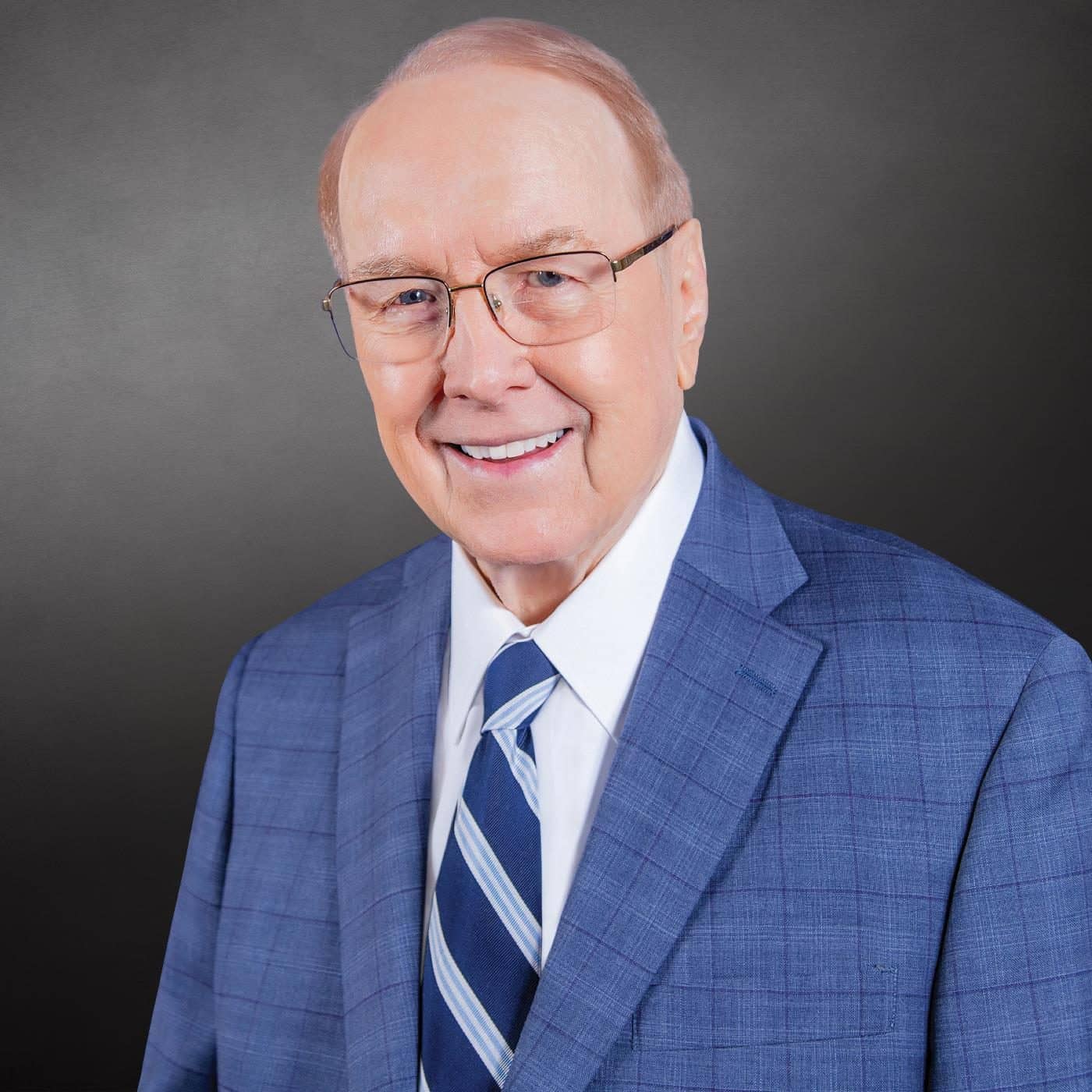
Join Pastor Greg Laurie as he interviews Dr. James Dobson in this heartwarming and enlightening episode of Family Talk. Discover how Dr. Dobson’s legacy continues to shape and inspire while delving into the impactful moments that defined his career. From his health journey and family dynamics to profound insights on fatherhood and faith, this conversation offers a glimpse into the life of a man who has touched millions. A testament to enduring values, this episode is a must-listen for anyone seeking encouragement and truth in their own life journey.
SPEAKER 02 :
Well, hello, everyone. I’m James Dobson, and you’re listening to Family Talk, a listener-supported ministry. In fact, thank you so much for being part of that support for James Dobson Family Institute.
SPEAKER 01 :
Well, welcome to Family Talk, the broadcast ministry of the Dr. James Dobson Family Institute. I’m Roger Marsh, and you know, for nearly 50 years, Dr. James Dobson served as an encourager who equipped families to stand for righteousness in today’s culture. On August 21st, early that Thursday morning, Dr. Dobson entered eternity and received his eternal reward. But before he did so, he guided countless families to model healthy marriages and healthy parent-child relationships as they grew closer to God. On today’s edition of Dr. James Dobson’s Family Talk, we’re going to revisit a conversation that was held when Pastor Greg Laurie stopped by the studio and basically took over. For nearly three decades, Greg Laurie has been leading Harvest Crusades all across the United States. Nearly six million people have attended in person at locations like Angel Stadium in Anaheim, Southern California, and also Madison Square Garden in New York. In addition, Almost 4 million people have attended Harvest events virtually as well over the years. The Harvest Crusades are large-scale evangelical events that have touched the lives and hearts of millions of people. And God has truly used both of these men, Dr. Dobson and Pastor Greg Laurie, in remarkable ways. On today’s broadcast, you’re going to hear Greg Laurie sit down with Dr. Dobson to share some stories from their respective journeys. But in this episode… They’re actually going to be swapping places as hosts and guests. So now let’s join our special guest host for today, Greg Laurie, and his special guest, Dr. James Dobson, as we revisit this special memory here on Family Talk.
SPEAKER 03 :
Hey, everybody, this is Pastor Greg Laurie, and I have hijacked the studios of Family Talk Radio. I am holding as my hostage Dr. James Dobson. No, I’m just kidding. He’s not my hostage, but I’m turning the tables.
SPEAKER 02 :
We’re going to throw you out of here, too.
SPEAKER 03 :
I’m turning the tables on the good doctor today because I want to interview Dr. Dobson a little bit so you can hear a little more of his story. Here’s some things you may not know about this familiar voice you hear on the radio every day. First of all. Dr. James Dobson is one of the most influential Christian leaders of this century. God has used him in a remarkable way in my life, in your life, and in so many others. Jim Dobson was born on April 21st in 1936 in Shreveport, Louisiana. He earned a Ph.D. in child development at USC. He was an associate clinical professor of pediatrics at the USC School of Medicine for 14 years. He spent 17 years on the staff of the Children’s Hospital of Los Angeles in the Division of Child Development and Medical Genetics. Am I correct so far, doctor?
SPEAKER 02 :
I think you got it. Okay.
SPEAKER 03 :
And this is interesting. Dr. Dobson has also served government advisory panels and testified at government hearings. He’s had a close relationship with multiple presidents. Of course, Dr. Dobson has written many books that we’re all well aware of, from Dare to Discipline to Bringing Up Boys, Bringing Up Girls, A Strong-Willed Child, What Wives With Their Husbands Knew About Women, When God Doesn’t Make Sense, and many more. And I would just like to say on a personal note, Dr. Dobson, when Our son Christopher went to be with the Lord in 2008. You called me, and we spent about an hour on the phone. And that familiar voice that has brought encouragement and comfort to so many on the radio, you were there for me. And, you know, I want to thank you for that. And I want to say, you know, God has given you this opportunity. Well, first of all, you look great. I mean, we’re on radio, but people can’t see you. You have like no wrinkles and you’re vibrant. And you look like you’d look when I saw you about five years ago. Do you have you found the fountain of youth or some special serum we need to know about?
SPEAKER 02 :
Well, the Lord’s been good to me, Greg, really. I had a heart attack, and it was a major heart attack. I have a total blockage of the main artery down the front of my heart. And that means you lose the bottom part of the heart, which is where the pumps are. And my heart is beating like that of a younger man who hasn’t had a heart attack. and i’ve also had a stroke after that that was eight years later and and i’ve had prostate cancer and i’m healthy today last summer i just decided to see what’s going on with me and i went to six doctors i went to a cardiologist i went to an ophthalmologist i went to a dermatologist i went the whole route and not one of them found the thing to remark about. And that’s just, the Lord has just said, I’m not through with you yet. I guess, I hope.
SPEAKER 03 :
So what is the difference between like say turning 60, then turning 70, then turning 80?
SPEAKER 02 :
How do you see it at that point? I don’t feel any different. I’m doing the same work that I was doing then. I have the same objectives, which is to serve Christ with all my heart, soul, and mind. And, you know, I still have a lot of fun in life. I hunt. I fish. I love football. You still play tennis? Yes. I can’t play tennis because the heart attack that I had makes it difficult to run. But I exercise every day. And as a matter of fact, on the 14th of December was my 23rd year of everyday exercise. I think that may account for some of it.
SPEAKER 03 :
What does a typical day of exercise look like for you?
SPEAKER 02 :
It’s 45 minutes, mostly on the treadmill. It’s mostly cardiovascular and physical. I just don’t allow myself options. I just do it. I’m tired of it. I’m bored with it. I wish I didn’t have to spend the rest of my life doing that. But if that’s what it takes to live another healthy day, I’m willing to do it.
SPEAKER 03 :
That’s right. And I saw an advertisement in a magazine once a number of years ago. It was a computer magazine selling some product. But I love the headline. The question was, is it an alarm clock or a calling that gets you out of bed in the morning? And I think for you, it’s not an alarm clock. You have passion and you have this passion now that you had as a much younger man. And this passion is maybe not as strong. Maybe it’s stronger than it’s ever been.
SPEAKER 02 :
Would that be an accurate statement? There’s no question about it. When you see the time is short. And it is for all of us. But, you know, as the years go by, you recognize it more. You realize that you don’t want to waste a minute. You’ve got things to do because the Lord has called you to do something.
SPEAKER 03 :
That’s exactly right.
SPEAKER 02 :
And I’m just loving life. Shirley and I are having a great time together. And we’ve got grandkids that I love like crazy.
SPEAKER 03 :
I love grandchildren.
SPEAKER 02 :
Yeah.
SPEAKER 03 :
You know, it’s been said that grandchildren are the reward for the pain your children put you through. And then it’s the punishment on them for what they did to you, right?
SPEAKER 02 :
You just hope one of them’s strong will so they get paid back.
SPEAKER 03 :
Yeah, didn’t you write a book with that title? Now, in your biography, Family Man, you were quoted to say the two most important things to you are, number one, ensuring your family and loved ones get to heaven. And number two, living the best possible Christian life. Why are these two things so important to you?
SPEAKER 02 :
Well, those are the eternal values. That’s what we read in the scripture. And I believe it, that we’re here for a purpose. So it’s just to serve the Lord and then do what he has called us to. You know, my great grandfather found the Lord and when he was a young man and he began praying, he was a minister, began praying that the Lord would become real to each one of four generations yet to come. I’m the fourth generation down. And I am the first member of four generations that hasn’t been called into the ministry. I would have done it if the Lord asked me to, but he didn’t. And so that has been really my life. I’m doing the same thing. You know, I haven’t really veered very much from four generations of people who who love the Lord with all their hearts. And I’m very blessed by that.
SPEAKER 03 :
Well, you know, when you think of the name James Dobson, you can’t help but think also of Shirley. You know, there’s certain names that are so familiar. Ron and Nancy Reagan. Billy and Ruth Graham, and James and Shirley Dobson. So for many years, Mrs. Dobson was running the National Day of Prayer, and Von Epp Bright was before her, right?
SPEAKER 02 :
That’s right. Yeah, and Shirley thought when the Lord asked her to handle that responsibility, she said to him in arrogance, I can do that for a couple of years, and She was there for 25 years, and she really did a super job. I’m telling you, that is one great lady. I fell in love with her in college. She was my homecoming queen. It took us three years to get married, and we’re still loving it, still loving being together. I’m telling you, if I had— to spend with anybody. It would be with Shirley, and it would probably be in our house, just the two of us together. She’s working on her thing, and I’m working on mine, and I never get bored with her. I just don’t.
SPEAKER 03 :
Did you meet on a college campus? We did, yeah. And do you remember the first thing she said to you?
SPEAKER 02 :
Oh, yeah, it’s an old story. Yeah. Yeah, I played a lot of tennis in those days, and… You know, you wear tennis shorts around the campus. And so she was coming toward me, and she saw me, and she wanted to know me and wasn’t sure how to start it, a conversation. And she got up to me and said, hi, legs. And so – I mean, anybody who loves my legs isn’t all bad. So that was the beginning.
SPEAKER 03 :
Now, you know, one thing that people may not understand is, you know, you started a ministry called Focus on the Family that you directed for many years. But now the name of your ministry is Family Talk.
SPEAKER 02 :
That’s right.
SPEAKER 03 :
And that’s a very important distinction. You know, God used you and blessed you to launch that incredible ministry of Focus on the Family. But now with Family Talk, you’re reaching a whole new generation of people. We started from scratch again, which is an interesting thing to do. Now, when we use the word family, I mean, this is a ridiculous question, but in this day and age, it’s not so ridiculous. Give us just your best definition of what a family is, A, and B, why a family is important.
SPEAKER 02 :
The family is the foundation. It’s the ground floor for everything in the culture. It all sits on that foundation. And if you undermine it and you weaken it, you’re undermining, you’re weakening the foundation. You know, the family was not man’s idea or woman’s idea. It wasn’t a Christian idea. It came along in the Garden of Eden with Adam and Eve. And the family was God’s gift to And he said, That’s the beginning of the family. You mess with that foundation. In fact, when the Supreme Court redefined to be anything you want it to be, or same-sex marriage, and who knows where that’s going. You’re also tampering with the model for the relationship between Christ and the church. Yes. And how dare we? How dare we do that? There was a design to the relationship, the fundamental relationship between a man and a woman. And we have now tampered with it, and I think we’re going to pay a price for it.
SPEAKER 03 :
If we don’t straighten around, you know, the Bible talks about sowing the wind and reaping the whirlwind. And I read a quote a while back that said a family can survive without a nation, but a nation cannot survive without the family.
SPEAKER 02 :
I absolutely believe that’s true, because, first of all, you’ve got the next generation at stake here. Yes. And what are they learning and what are they being taught and how much stability is there at that level? And if you don’t have the family straight and don’t have a clear perspective on how it’s to be lived, you mess up the next generation. And you know what happens when that occurs. We’ve got history all the way, 5,000 years of history to see what happens when the family begins to disintegrate. Exactly.
SPEAKER 03 :
And if you’ve just tuned in and you’re wondering, who is this guy on with Dr. Dobson? My name is Greg Laurie, and it’s my privilege today. to sort of turn the tables on Dr. Dobson and ask him a few questions. Dr. Dobson, coming back to the family and the breakdown of it, you know, you’ve talked a lot about fatherless homes. I came from a fatherless home. I was conceived out of wedlock. And I had a bunch of men that called themselves my stepdads. None of them behaved as a stepfather. And it set my life in the wrong direction. And, you know, you can almost take every social little today and trace it. to the breakdown of the family, a divorce, and a lack of a father. Here’s just a couple of quick stats. A child that comes from a fatherless home is 68% more likely to use drugs or alcohol, far more likely to become sexually active at an early age, and three times more likely to commit a violent crime. 63% of teenagers who attempt suicide live in fatherless homes. 85% of all youth sitting in prisons grew up in fatherless homes. Fatherless sons are 300% more likely to become incarcerated in state juvenile institutions. And it just goes on and on. So God must have known what he was doing when he established a marriage between a man and a woman and created what we call a family.
SPEAKER 02 :
That’s the way it’s designed, and that’s the way it works best. You know, many people, most people know that boys need their fathers. I mean, you have to teach those boys how to be men. They’re not born knowing that. But what many people don’t know is that girls need their dads maybe more than boys do. Why is that? Well, they’re very sensitive. They’re more sensitive, more complicated than boys, and they need affirmation. A girl’s self-esteem hangs precariously on the relationship between that girl and her father. He’s the first one to love her. He’s the first one to kiss her, first male to kiss her or to tell her that she’s pretty or that – to build her up in her own eyes. A father is desperately needed for that, and many men don’t get that. They know that they should take their boys fishing, and they ought to take them to baseball games and whatever. They don’t realize that they’re looking past those little girls. We had an organization called the Institute, and we brought really bright, smart kids, boys and girls. They were actually juniors and seniors in college to come to that institute. And when I started writing the book, Bringing Up Girls, I – excluded the boys. I brought in about 25 or 30 girls and did that on two occasions. I fed them a good meal and then I said, I want you to tell me what should be in this book. And Greg, it was amazing. They wept They were in a very safe environment, and they weren’t angry at their dads, but they felt like they did not even see them. And they would tell stories about how they longed to be with their dads, and what a girl needs from a dad. I call it the three Ts. They need time, they need touch. Put your arm around. Hug them. A girl needs to be hugged and talk. And there’s a couple of others, but those are the primary ones. Just sit down and talk. These girls who would come to the Institute would say, would you know my dad didn’t even ask me what we’re going to do here? I would try to tell him that I was coming to this institute on the family, and they weren’t interested. Not all men are that way, obviously. There’s a lot of great fathers out there, so we have to be careful what we’re saying here.
SPEAKER 03 :
Well, you know, when you think about marriage, I mean, this is the foundation of everything. And, you know, one thing I’ve always emphasized is, you know, your first priority is to Christ as a man or a woman. But then if you’re married, it’s to your spouse. And the best thing you can do for your children is to love their dad or love their mom. Keep that marriage strong. And, you know, here we’re talking about the importance of a father. But, you know, maybe there’s someone listening, Dr. Dobson, a dad who has walked away from a marriage.
SPEAKER 02 :
How did you cope with your circumstances? You had seven dads. None of them were dads to you. How did you deal with that? How did you come up to be a man’s man?
SPEAKER 03 :
You know, Dr. Dobson, initially I put armor on. You know, I had to learn how to cope. And so I became hard. I became cynical. And I carried that cynicism and that hardness through life. I also developed a sense of humor. A lot of times when you see comedians interviewed, they’ll talk about tortured childhoods. And I get it because you develop humor as a defense mechanism. You make light of everything, even when it’s not funny. But for me, what really changed me, of course, was when I became a Christian. And for the first time, I understood what a family should look like. I understood what a man should look like. I found some good godly male role models that were older than me. You know, when I was a new believer, as a young kid, I hung around mainly with older men. not people my own age, because I needed an example. I needed a model. And then when I got married, I wanted to be the best father I could be. And we’ve been married 42 years, and I wanted to be the best husband I could be. So I think the simple answer is I accepted Christ into my life. I read the Bible. I believed the Bible. I applied the principles of the Bible, which work because they’re God’s Word. Yeah, that saved you, didn’t it? I mean, it really did. It literally did. It literally saved my life. I could be dead right now because a lot of people in my family, I mentioned to you in another interview we did that in my family, they were either notorious sinners or notorious Christians. A lot of alcoholism in my family. Who knows what path I would have taken.
SPEAKER 02 :
Did you get into drugs?
SPEAKER 03 :
Yeah, I got into drugs. I got into drinking. I got into drugs more than I got into drinking. But I mean, I was using, I was smoking pot every day, taking LSD on the weekends. That was my lifestyle. And I wouldn’t say I was an addict, but I did it every day. But I came to a point even before I was a Christian where I thought, this is a dead end street and I can’t live this way anymore. But what do I do? Where do I go? What is life about? And that brought me to Christ. But Wait, hey, I’m interviewing you. Don’t start interviewing me.
SPEAKER 02 :
Let me offer something here. Okay, sure. Is this your show? You can do whatever you want. No, it isn’t my show. I’m in your office. This is family talk. We came from completely different environments. I had a wonderful father and mother. Yeah. And my dad was a godly man. I never saw him compromise. He loved me, prayed for me. And the day before he had his last terrible heart attack, he was off someplace praying for me, praying for his own future and what the Lord wanted of him. And the Lord said, you’re going to reach millions of people around the world, but it is not going to be through you. It’s going to be through your son. And then he had a heart attack. Wow. and was gone. So I had that kind of influence and background, and you had the opposite, yet here we are sitting here serving the Lord to the best of our ability. That’s a miracle.
SPEAKER 03 :
It is. And I think no matter what your upbringing is, if there’s a cycle of sin in your family, you can break that cycle. And you break it by committing your life to Christ and starting to do the right thing. I mean, there might be someone listening right now who has messed their family up. They’ve messed their marriage up. They’ve failed as a husband, as a father, as a wife, as a mother. Here’s what we would say to you. Repent and change your direction because look at the legacy of a father in Dr. Dobson’s life. And then, you know, I wanted to be that father for my sons. I didn’t have one, but I wanted to be that father for them. Who was your role model? Chuck Smith was a role model for me as he was a pastor. Billy Graham, who I actually got to know very well, was a clear role model for me. And then just other older godly men. They weren’t famous people. They were just guys who love God, love their wives, love their kids. And I would pick things up watching them, observing them. You’ve been a role model to me on the radio and then getting to know you as well. So I just looked for godly men that were living it and I followed their example. So, Dr. Dobson, thank you for letting me hijack your studio today. It’s been a privilege to interview you. And thank you for all you do. And our prayer is that you’ll keep doing it.
SPEAKER 02 :
Greg, I’m really proud of you. I’m proud of the way you’ve lived your life. I’m proud of what the Lord is doing in your church and through your evangelistic efforts. And the end is not yet. Amen. Thank you.
SPEAKER 01 :
And with that, we conclude this classic special edition of Dr. James Dobson’s Family Talk. I’m Roger Marsh, and in honor of acknowledging Dr. Dobson’s passing a couple of weeks ago, we felt it appropriate to revisit this conversation where pastor, author, and evangelist Greg Laurie stopped by the studio and actually took over the host chair and interviewed Dr. Dobson about his life in ministry. If you enjoyed this Family Talk program and you want to share it with a friend or family member, remember you can easily do that when you visit our website at drjamesdobson.org. That’s drjamesdobson.org. Once you’re there, be sure you also check out the memorial page that we’ve established for Dr. Dobson as well. Share some great memories and some wonderful recollections. And we would like to encourage you to leave a recollection and a memory as well. You know, sometimes life isn’t easy, but you know, Sometimes the circumstances in life just don’t add up, and that’s where the wisdom of what Dr. Dobson has written about. You think about his book, When God Doesn’t Make Sense, or the 10-Day Email Series. Those have been such a huge benefit to so many people all throughout the years, and that’s just one example. Dr. Dobson published more than 70 books during his lifetime here on Earth, and that legacy continues as the JDFI looks forward to our next season of ministry. which is going on right now. Your prayers and faithful financial support make that possible. So when you go to drjamesdobson.org, leave a memory in our memory book of the ways Dr. Dobson’s ministry has impacted you. But also if you think about it, make a donation as well, a memorial gift to help continue the work of JDFI into the future. Again, go to drjamesdobson.org and handle that transaction online. You can also do so when you call a member of our constituent care team at 877-732-6825. That’s 877-732-6825. Or if you prefer, you can send your memory and your tax-deductible donation to our ministry mailing address. That is Dr. James Dobson’s Family Talk, P.O. Box 39000, Colorado Springs, Colorado, the zip code 80949. Well, I’m Roger Marsh, and on behalf of all of us here at the Dr. James Dobson Family Institute, thanks so much for listening today. Be sure to join us again next time right here for another edition of Dr. James Dobson’s Family Talk, the voice you can still trust for the family you love. This has been a presentation of the Dr. James Dobson Family Institute.