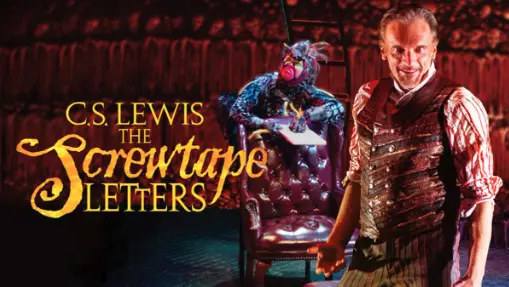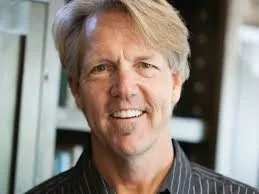

Join us for an insightful conversation with Max McLean, the mastermind behind the stage adaptation of C.S. Lewis’s classic, The Screwtape Letters. Dive deep into the intricacies of transforming a beloved book into a compelling stage performance. Discover the challenges and triumphs McLean shares as he revives Lewis’s timeless message on spiritual warfare and redemption for modern audiences. In this episode, we explore how McLean’s dedication to faithfulness and creativity brings new life to Lewis’s words. Experience the magic of storytelling as the play captivates both longtime fans and new believers alike. From its inception in 2005 to its
SPEAKER 02 :
KLTT listeners, I have a treat for you today. If you love C.S. Lewis, you’re going to love Max McLean. Max McLean is the president and the artistic director for Fellowship for the Performing Arts. He’s the lead actor, director, and author of the adaptation of The Screwtape Letters, which you can see right here in Colorado Springs or Denver in August. Super excited to talk to him. Max, how are you this evening?
SPEAKER 03 :
Well, thank you for having me. I’m doing well.
SPEAKER 02 :
Yeah, super excited for The Screwtape Letters, one of my favorite books, and I’m sure our listeners are the same. It seems, though, looking through a lot of the other stuff that you’ve done, I mean, you’ve done theater and film for just about every C.S. Lewis book that exists from, you know, even the deep cuts, Mark’s Gospel or Martin Luther on Trial. What is it about C.S. Lewis that just draws you to him? Why C.S. Lewis?
SPEAKER 03 :
Well, it started, uh, I’m an adult convert to Christianity in my twenties, right after college. And right after reading the new Testament, uh, someone gave me, uh, this who take letters. So, uh, and at that time, um, I was incredibly impressed by his exploration of spiritual warfare. And being a new Christian, I was very aware of that. And he was, in the book, The Screwtape Letters, just pinpointed certain areas that I said, oh, wow, it’s the small things that become the big things. And of course, before you were a Christian, you have almost no awareness of the devil, no awareness of spiritual warfare, you know, and of course that’s what the devil likes. So being aware that we must not be ignorant of his devices, as Paul says, that he masquerades as an angel of light, and therefore we have to guard our hearts and put on the armor of God, that was a really good introduction to C.S. Lewis.
SPEAKER 02 :
Yeah, he does that well. And like you, I was the same way a little later in life. I was in my 40s when I came to Christ finally. And what an amazing way to spread the gospel, and especially with that spiritual warfare that some people think is icky and stay away from it. What challenges did you have? Because C.S. Lewis is, like you said, he’s so meticulous in idiom and the different ways that he writes. What challenges did you see? adapting that to the stage and bringing it to life. You know, what’s kind of, what’s kind of neat is I’ve watched a lot of YouTube videos and our listeners can go to YouTube and search for the screw tape letters and Max McLean. Um, what you’ve produced is I’ve, I’ve read screw tape letters probably seven or eight times. And what you’ve produced is almost exactly what was in my head. So what challenges did you have adapting that to the stage from his writing? Um,
SPEAKER 03 :
Well, he never intended the Screwtape Letters to be a play or a film. He actually wrote it as a kind of reversed emotional, creating a morally inverted universe where up is down, good is bad, God is called the enemy. Satan is called our father below, so that we could see how temptation works from the devil’s perspective, you know, what his intentions are, what his objectives are. And so all of a sudden, your imagination is immediately hooked in and you see things that you wouldn’t see if it was just, don’t do this, don’t do that. It was like, it was just the opposite. So the first challenge is creating this morally inverted universe, you know, graphically, scenically. And then we also were very committed to being faithful to the book. uh so uh if you if you get the audiobook of the screw tape letters uh it’ll take you about six hours to go through it uh obviously people don’t want to stay that long so our adaptation is is roughly 90 minutes uh but in that 90 minutes there’s 31 letters in the book it’s an epistolary novel there’s 31 letters in the book Our play touches on 24 of them. But more importantly, from a theatrical perspective, what is the story? What is the arc that happens in the book? And essentially, it is a predator-prey story. Screwtape is the predator. It’s an interesting phrase. The patient, who is this unsuspecting human on Earth, is the prey and and it’s interesting that lewis calls him the patient or scrutiny calls this unsuspecting human on earth the patient because you and i think of a patient as someone in need of healing uh in in this case the patient is someone in need of corrupting of damning of bringing towards damnation and and the other uh insight in the book and it comes in our play is that uh Human souls are nourishment for demons. So there is this sense of hunger and food, which is, you know, the whole predator motif. So we really stuck to that. And then following that, we created two what we say story arcs. all using Lewis’s words. So there’s this depth and perception and magnificent use of language. And the two story arcs is, A, what happens to the patient who begins the story as, basically indifferent to Christianity, indifferent to spiritual things, and by the end of the play, he is… he dies in a state of… he’s in a state of grace. Yeah, come on. And this in spite of all the efforts of Screwtape to ruin him, right? Yeah. So that’s one story arc. And then the other story arc is… What happens to Scute, who begins the story as this master of the universe character who loves the way he looks, loves the way he talks, loves the way he dresses, smartest guy in the room, pure pride. And by the end of the play, he is a defeated devil.
SPEAKER 02 :
Hey man, you got it. That’s awesome. What a great way to put that. It sounds like it’s so intricate and, and you’ve taken kind of taken CS Lewis’s cue and the intricacy of his writing and adapted that in three dimensions. I love that. What, what’s his, what’s been the response so far with that adaptation? You guys have run this a little bit now, what for a year and a half now?
SPEAKER 03 :
We’ve done Oh, well, I mean, this current tour is a year and a half, but we began working on this. We got the rights from the C.S. Lewis estate back in 2005. Amazing. And so we’ve had multiple productions of it. It ran in New York for nine months. It ran in London, had a six-week sold-out run in London. Wow. It’s had multiple national tours. The New York City revival in 2018, when we brought it back to New York, was listed by Newsweek as one of the best shows of the year in New York City. So it’s had a tremendous… sense of acclaim in both Christian and non-Christian circles. But from an audience in Denver, an audience in Colorado Springs, what will they experience? Since it’s theater, We want our audiences to be entertained, to have a good time, to enjoy, to laugh, to experience something unique and different. That’s one. But in the process of enjoying a sort of artistic theatrical experience, And what tends to happen is you’re engaging the imagination, you know, like watching a movie and all of a sudden you’re kind of convicted by some real truth that’s there. And for some people, according to some of the letters we get, it’s a life-changing experience.
SPEAKER 02 :
what’s unique about screw tape um what made you i guess what made you kind of pull your hair out um versus other productions that you just had to work that much harder on with screw tape well the the the
SPEAKER 03 :
The way it’s written, you know, the language is all Screwtape talking to a wormwood about the patient. And one of the things that we knew we didn’t want to do was have Screwtape behind a desk writing letters. We wanted to have free range of the stage. And in doing so, we created this really expansive theatrical world that has demons in it. There’s a character called Toadpipe. that handles all the letter management in this very entertaining way of taking the dictation of sealing the letters. We’ve got this incredible system of getting the letters to Earth, which when we did the show in D.C. many years ago, the reviewer said, looking at the communication system we developed, that that it said, hell, it has to have one of those. So it’s been a very strong creative team because we had a great set designer, costume designer, composer. So all the elements of theater, and theater is a very collaborative experience, all working on a text. with the objective of giving the audience a satisfying theatrical experience. So that was a challenge, and I think we’ve achieved it.
SPEAKER 02 :
Amazing. Man, it just sounds so intricate. I keep using that word, but so well planned out. Has it evolved at all with the length of that tour run? Has anything changed? No. Not really.
SPEAKER 03 :
I mean, from 2005 to 2010… We had multiple development productions, you know, theater and like film. It’s a long sort of process. But once we got to where it needed to be, which is roughly around 2010, it hasn’t changed much at all. I mean, we’ve had different actors. We’ve had lots of different actors. The current actor that’s playing Scutate, And in both Colorado Springs and Denver is Brent Harris, who’s been with the company since 2012. And when we hired him, he had just finished his run as Scar in The Lion King, which is, of course, the story of that story. So he’s perfectly cast and has been a fantastic screw tape. We’re currently right now rehearsing a standby for him that will also go on. And this new actor, Greg Jackson, has multiple major roles on Broadway. So we’ve got strong, strong cast to tell the story.
SPEAKER 02 :
One of the things I’ve also loved about this particular book is that, though it was written in the 40s, I think, right? Yeah. It’s sort of timeless. There’s been a lot of a lot of attempts to update it. I saw one about it was like an email system or something like that. Is this super true to the book? Have you updated it at all from C.S. Lewis’s writing?
SPEAKER 03 :
Yeah, we did a couple of small ones recently. It was set during World War II. And so there are certain references to the Germans. And we did feel that was a bit anachronistic also. So we did update, I think, two separate references to terror or terrorists. And they actually fit very well. Because they’re really, in one of the prefaces to the Scoot Tape letters, Lewis wrote, the fact that these humans go to war from time to time is of no interest to us except as how it impacts humanity. the spiritual life of the patient. Yeah. So, uh, so we, we took that as a cue that we could make that little update. Uh, we, we have some visual representations that are much more contemporary than the forties. However, the words that we use, uh, don’t change, which tells me that Lewis is dealing with universal themes, mostly dealing with the seven deadly sins. And so if you’re dealing with your sinful nature, I think that rings true for anyone who has ears to hear and eyes to see.
SPEAKER 02 :
Yeah, for sure. And I think, you know, spiritual warfare hasn’t changed today from 6,000 BC. It’s all the same story. So, um, that, that gives me the, the spiritual warfare chills. When I think about it, it’s, it’s just amazing how consistent that would have to be and how people like you and CS Lewis have, have kept that. It’s awesome. Um, As a music producer myself, as a creative, the logistics of something like this is really interesting to me. So this is a one-day show coming through town with super explosive, intricate sets and wardrobe and all that kind of stuff. Is there any unique challenge to a one-day show like that where you’re just blowing through town kind of thing?
SPEAKER 03 :
Yeah, yeah. I mean, it’s kind of a NASA space launch, you know. You really have to do a lot of advanced work, you know, with the venue, making sure that they have the lighting and the sound, or if they don’t have it, make sure we get it. You know, we travel with a 53-foot tractor trailer that, you know, goes from place to place. We used to do smaller venues and stay a little longer in places. More recently, we found it to be better to go to a little bit bigger venues like Bikes Peak in Colorado and Third Opera House in Denver. uh to uh so that we can get in and out in one or two days uh and it’s uh because you know obviously travel you know hotels and all that’s really expensive and and of course we you know we’re the producer of the event so you know we we have to cover all the fellowship for performing arts which is a a not-for-profit ministry that produces theater and film from a Christian worldview meant to engage a diverse audience. So, you know, we, we look at, we have a booking department that looks for available dates in various cities. We, then we build a tour and make sure that the, that the routing works. So all of those things are really a big part of what we do.
SPEAKER 02 :
That sounds like a monumental undertaking for sure. And you mentioned Fellowship for the Performing Arts again. Why don’t you tell us a little bit about what FPA does, some of the other stuff you’ve done, and then we’ll button it on up.
SPEAKER 03 :
Fellowship for the Performing Arts, as I mentioned, it’s a… is a theatrical and film production company based in New York that tells stories, good stories from a Christian worldview, meant to engage a religiously and intellectually diverse audience. And so the way we do it is we select the right material, which we think will speak to a diverse audience, such as… C.S. Lewis material and material from the Bible, then we execute it to the highest levels that our budgets will allow so that we can play the great theatrical venues around the country. And then we ask people to help us do it. And that’s why we’re called Fellowship for Performing Arts. It’s a fellowship of people who believe that art, theater, film, from a Christian perspective, can capture the imagination and leave room for the Holy Spirit to do His work.
SPEAKER 02 :
There you go. Spreading the gospel creatively. I love it. So give us the 15-second pitch, Max. Why do I need to come see the Screwtape Letters at Pikes Peak Theater on August 3rd?
SPEAKER 03 :
Well, if you love C.S. Lewis and you know the Screwtape Letters, well, it may be a little longer than 15 seconds. Yeah, go ahead. Many people find the Screwtape Letters difficult to read. And what we provide is a faithful adaptation of of the book that really brings it down to a level because it’s so visual and so clear that it makes it really easier to understand what Lewis is saying. And therefore, it motivates people who haven’t read the book to read it, who’ve started it but didn’t finish it. to pick it up and finish it, and then for people that had never read it to pick it up and read it for the first time.
SPEAKER 02 :
There you go. And I think I have, if I recall, when I first read that book, I had to read it two or three more times before it really started clicking. So I’m with you. You heard it here only one night, August 3rd at Pikes Peak Theater in Colorado Springs. The Screwtape Letters, you can find them at 670KLTT.com slash events, or you can go straight to screwtapeonstage.com and you can find all the videos and sets and things like that. You can get as excited as I did. Max, it’s been a joy to talk to you today. Super proud of the show and I cannot wait to see it.
SPEAKER 01 :
Thanks so much for having me.