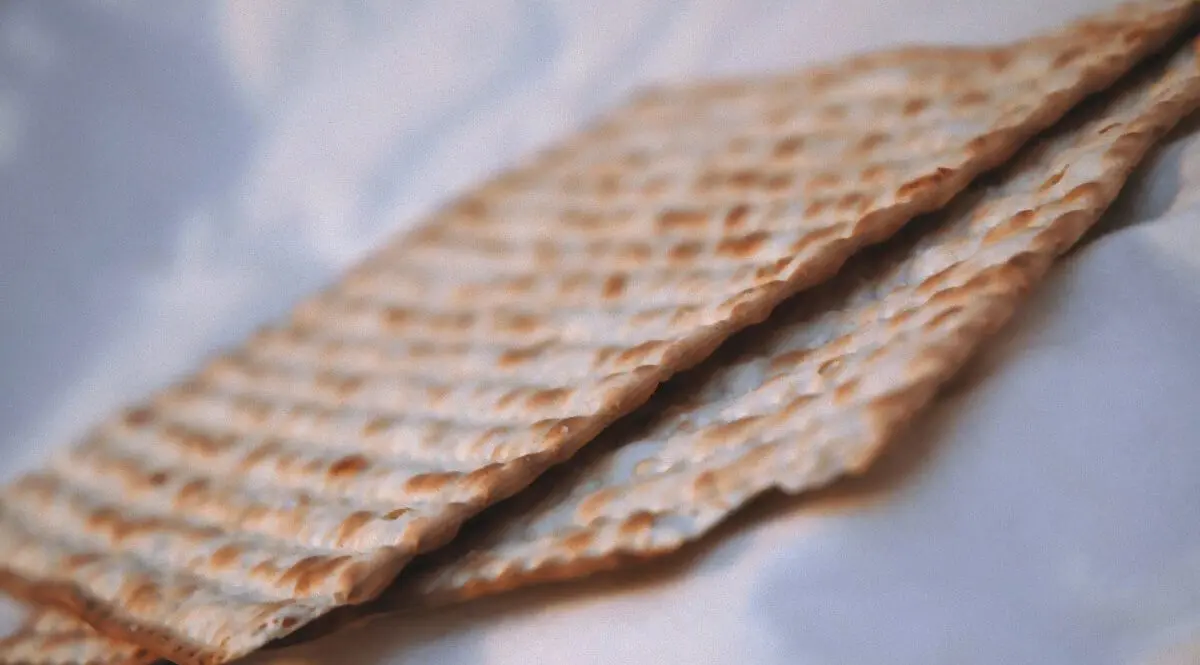
In this enlightening episode, we delve into the fascinating tradition of eating unleavened bread during Passover. The custom is steeped in rich history and significance, particularly amongst Jewish communities who observe this for eight days. We explore how this practice originated and the intriguing way it reflects the broader historical and religious context of Passover.
SPEAKER 01 :
Why on earth do we eat unleavened bread for seven days, or if we’re Jews, for eight days? Does that surprise you, by the way, that the Jews eat unleavened bread for eight days? Someone sent me a greeting card this year, and it was a cute little greeting card. It was… It was the how to survive on matzos, you know, during Passover. And it said day one, and it had matzos and peanut butter. And day two, it was matzo ball soup. And it went on through all the different things you could do with matzos. What was fascinating was there were eight days, not nine. I’m sorry, not seven. And the ninth day showed a garbage can full of matzos and matzos boxes and leftover matzos. They were glad to get rid of it after eating it for that many days. And I looked at it, and I blinked a couple of times and sent a note back to the girl that sent it to me about calling it to her attention. She had noticed it but hadn’t thought much about it. Well, what’s going on there is the fact that it’s custom among the Jewish people on the night before Passover to go through the house, do their search for leaven, they get it all together, and they burn any leaven they find. So guess what’s left to eat the next day? Matzos, unleavened bread. So consequently for them, day one is what for us is the day before. It was yesterday, before we actually started. That’s not our custom. We get the leavening out before sundown last night, and we observe seven days of unleavened bread. I think that probably grew out of some of the period of time of the Jewish sages who were building fences around the law, and like putting the official beginning of Passover at a half hour before sundown, sorry, of Sabbath, and Sabbath not ending until a half an hour after sundown. So let’s be sure that we have all the leavening out, we get it all out the day before, that way we have the next day to discover all those things that we overlooked and forgot to. In fact, it’s part of their custom, just to underline the possibility of hidden leaven, is that they hide a piece of leaven somewhere in the house. And the search goes on for it until finally somebody finds it, and then they feel comfortable that they have finally found the last of the hidden leaven in their homes, and it’s an eight-day thing. Now, as I said, this is why the gospel writers, you know, referred to the day that the Passover lambs were killed as the day of unleavened bread, the lambs were killed, or the first day of unleavened bread, because for them it was. But it was not the 15th day of the month. It was the 14th day of the month. But why this strange custom? Because it is, I would think to anybody passing by and considering what we were doing, it’s a rather strange custom. Now, people who boil eggs, though, and dye them different colors and maybe paint designs on them and go out and hide them around the yard for their children to go hunting for these eggs and then tell their children that those eggs were laid there by an Easter bunny, I don’t think they have any standing to refer to eating unleavened bread for seven days as a peculiar custom. I remember one day that we were in a hotel in Chicago. We were having brunch, and it was Easter Sunday morning. And in the door bounds a giant rabbit, size of Harvey, I suppose. And it bound to be at least a six-footer behind underneath that costume. with a big basket full of eggs bounding around the room and giving little candy eggs to all the children in the room, and all the adults, I guess, that wanted them. On this morning, I would think if an Arab visitor to our country who had no idea of any of these customs saw that happen, he would have probably almost felt like running out the other door in fright at the appearance of this giant bunny rabbit in this restaurant. Most people who do this, by the way, have not a clue where it came from. And I’ll just send you back to the encyclopedias to see where it came from because it is an interesting story all by itself. But then never once think about where did it come from. At least our peculiar custom of eating unleavened bread for seven days, we know precisely where it came from. And we talk about it whenever it comes around each time of the year. It’s a hard story, though, to know where to begin. Because when you come to the Passover itself, you come in the middle of things. And it’s hard, as I say, to back up a little ways and find out where shall we begin the story. But thanks to Cecil B. DeMille and Charlton Heston, most of us have a fairly good idea of what went before this. And so I’ll take the liberty of starting today with Exodus 11. You might want to turn there with me because this will be something of a Bible study today. Exodus chapter 11. You all know that there was a sequence of plague after plague after plague that God brought upon the Egyptian people. I think that Yul Brynner in Exodus played the part of Pharaoh perfectly. An arrogant man, a man full of himself, a man who had never been denied in his lifetime anything he ever wanted, whatever he gave as a command was to be done. And consequently, when a man like that is challenged to let go from his country, a large slave population, it didn’t really require a great deal of effort to harden his heart against them, do you suppose? In fact, there is every indication, as you read through the biblical account, that Pharaoh’s heart was hard to start with. How did Pharaoh’s heart get softened? One plague. Actually, it wasn’t even just one plague. It was a series of plagues to where he finally began to relent. Now, then what did it take to re-harden his heart? Because he didn’t let them go. If you remember the story, there was plague after plague, and finally Pharaoh says, get out of here, I can’t stand any more of this. But that was a long time before they actually got out of Egypt. Why were they not able to go? Scriptures tell us that God hardened Pharaoh’s heart. How did he do that? Well, it’s a relatively simple process. If you softened his heart with a plague, you harden his heart by removing the plague. When the plague was over, Pharaoh reverted to what he was before. His word was what he said it was. Whatever he decided was his word was his word. So if he gave you his word you were leaving yesterday, he can tell you today, no, today I’m giving you my word that you’re not leaving. And that’s what happened. And it happened again and again. Then we come to this 11th chapter after a long series of plagues. And the Lord said to Moses, I’m going to bring one more plague upon Pharaoh and upon Egypt. Afterward, he will let you go. When he shall let you go, he shall surely thrust you out hence altogether. We’re not going to be just saying, oh, well, go ahead and leave. They’re going to have their hand in your back as you go. Speak now in the ears of the people and let every man borrow, and the word really is take, of his neighbor, every woman of her neighbor, jewels of silver and jewels of gold. And the Lord gave the people favor in the sight of the Egyptians. Moreover, the man Moses was very great in the land of Egypt in the sight of Pharaoh’s servants and the sight of all the people. Now, Pharaoh was one thing. All the people were something else entirely. Moses was considered a very great man by the people of Egypt, as did even Pharaoh’s household consider him a very great man. And as strange as it may seem for the Israelites to be asking jewels of gold or silver and so forth from the Egyptian people and receiving them, God having given them favor, there’s a natural follow-on to this. These people had suffered all these plagues. And these people understood, from all being known, the word goes around, what it was that was going on. And so there was an awareness among the people of Egypt at this time of what was happening, the manifest unfairness of it. Moses was a great man, and so when they asked him for jewels of gold and so forth, said, we’re going to be leaving here, the people gave it to them. And Moses said, thus saith the Lord, about midnight I will go into the midst of Egypt. And the firstborn of the land of Egypt will die from the firstborn of Pharaoh that sits upon his throne, even to the firstborn of the maidservant that’s behind the mill and the firstborn of every beast. The firstborn of everybody and everything is going to die when I come through here. You know, you keep hearing people talking about the death angel, the death angel, the death angel. It doesn’t really say that. God says, I will pass through the land of Egypt this night. And the firstborn of every household, of your dogs and your cats, your animals, your birds and what have you, they’re all going to die at the presence of God. I suppose you could say that God slew them. But the very presence of God itself may have been enough to do that. But in any case, whatever the way in which it worked, he did it. Now, there may be a case to be said for the fact that there was an angel that was actually involved in this, because I think God acts through angels still in the first person, as though it were he doing it, even though it’s an angel that actually does the deed. But there’ll be a great cry throughout the land of Egypt, such as there was nothing like it, and there never will be another one here. But against any of the children of Israel, a dog will not even bark against them. Why are we going to do that? It’s easy. I want everyone to know that the Lord is putting a difference between the Egyptians and the Israelites. Not even a dog is going to bark at you. Nobody is going to yell at you. There’s not even one word lifted in this night against you. And all these, your servants, shall come down to me, and they will bow themselves to me, saying, Get out, and all the people that follow you, and after that I will go out. And Moses went out from Pharaoh in great anger. This message is delivered to Pharaoh, by the way, as to what God is going to do. And the Lord said to Moses, Pharaoh will not listen to you, that my wonders may be multiplied in the land of Egypt. And Moses and Aaron did all these things before Pharaoh. That’s a reference back to the whole sequence of things that they had done in Pharaoh’s sight. He said he did all these things, and the Lord hardened Pharaoh’s heart so that he would not let the children of Israel go out of his land. Paul mentions this all the way over in the New Testament. It is such a dramatic thing in his mind that this man, even though he was brought to relent on several occasions, in the end, God hardened his heart, would not allow him, in a sense, to be soft and yielding and to allow this thing to take place because he intended that the events of this night happen. A sobering thing to consider. And the Lord spoke to Moses and Aaron in the land of Egypt, chapter 12, verse 1, saying, This month shall be to you the beginning of months. It shall be the first month of the year to you. Now, this is an important verse. It’s important for a curious reason. This is the only, absolutely the only scripture in the entirety of the Bible that gives any instructions regarding the calendar. You can search it from beginning to end and you will find nothing else. Now, you’ll find inferences. You’ll find inferences having to do with calendar items from place to place. And yet, if we get to a situation in the 20th century, we’re looking back on this, and he says this month shall be the beginning of months to you. How do we know what month of the year that was? The Bible doesn’t tell us. You can actually search your Bible carefully, and you will never find any reference here to tell you which month this was. Well, the month’s name is Adar, green ears, and that sort of tells you that it’s something having to do with the spring, but is it the month in which the green ears appear? Is it any month in which the green ears are? It’s really difficult to know with any certainty precisely what he meant by this. And I think it’s rather interesting to me that whenever God said this to Moses and Aaron, they didn’t say, Lord, what’s a month? They knew what a month was. A calendar existed. What God says is, this month, which you know what a month is, is going to be the beginning of your calendar system that’s going to follow on ahead. We’re going to go through it. And this is all there is. Everything else… has to be passed on down to us by tradition. Simple as that. Speak you to all the congregation of Israel, saying, In the tenth day of this month they shall take to them every man a lamb, according to the house of their fathers, a lamb for a house. However, if your household is a little too small for a lamb, you know, there are only, let’s say, three of you in the household, and not all of you can eat a whole lamb in one night, well, then you get with your neighbor in the next house, And you make it according to the number of the souls, every man according to his eating. You shall make your count for each lamb. So you go from house to house, you work it out, and you apportion your lamb so that the right amount of meat is available for each house. Your lamb is to be without blemish, a male of the first year. You take it out from the sheep or from the goats, either one. Easy to forget. It’s not always a lamb. It was sometimes for some families a kid. And you shall keep it up until the fourteenth day of the same month, and the whole assembly of the congregation of Israel shall kill it in the evening. Now, among churches in our tradition, reams of material have been written on this particular subject as to what this means and whether or not this was last night or yesterday afternoon when this took place or whether it was the evening before that on the beginning of the fourteenth that this took place. Now, I’m going to make a statement to you that if you did not have the New Testament to confuse the issue, no one would ever have a question that this was yesterday afternoon that he’s talking about, that it was toward the end of the 14th that this lamb was killed. I will show you why this is so as we go along. The only reason it is a problem is because of the synoptic gospels. That’s Matthew, Mark, Luke, and Matthew, Mark, and Luke. I almost added John. John is not one of the synoptic gospels. all of whom seem to say that Jesus ate the Passover on the night beginning the 14th. And as a consequence, everybody’s throwing up in the air and saying, well, that must have been the real Passover. And the Jews, which John says we’re about to keep the Passover, we’re keeping the Passover a day late. And this is tossed around by many people. But as I say, there would not be a question in your mind about this if all you had was the Hebrew language and the Old Testament. It killeth in the evening. They shall take the blood, and they’ll strike it on the two side posts of the upper doorpost of the house wherein they shall eat it. And they shall eat the flesh in that night, roast with fire and unleavened bread, and with bitter herbs they shall eat it. Eat not of it raw, nor sodden at all with water. Raw lamb? I suppose some people do. Anyway, don’t eat it raw. Don’t eat it boiled with water. Roast it with fire. The head, the legs, the appurtenance. I mean, we’ve got a whole lamb roasting on the fire. And you shall let nothing of it remain until the morning. And that which remains of it till the morning, you burn that with fire. This is not to be left lying around. Now here is how you’re supposed to eat this lamb in the night in which you eat it. With your loins girded, your shoes on, your staff in your hand, and you eat it in haste. It is the Lord’s Passover. Now why do you do that? Why with your shoes on, why your staff in your hand, in other words, fully dressed for the road. That’s what that little added thing with your staff in your hand is talking about. You are ready for the road. Now, let me ask you this. Why do this if you’re going to eat the Passover, then undress and go to bed, sleep until morning, get up in the morning, dress, go around all day long spoiling the Egyptians, and then finally leave after dark the next night? That’s the construction that had to be put on this when the question of whether Jesus was keeping the Passover on the appropriate time, the time of the original Passover, or whether he was keeping it a night before the original Passover. And again, that’s a question I’m not going to try to deal with today. That’s a much later issue. But it’s because of this question that arises out of the Synoptic Gospels that any question arises about this at all. Listen to what he says. I will pass through the land of Egypt this night. I’ll smite all the firstborn of the land of Egypt, man and beast, against all the gods of Egypt will I execute judgment. And in fact, the lambs that they killed were godlike people to the Egyptians. They were actually killing and eating Egyptian gods when they killed a kid or a lamb. He said, I’m going to execute judgment against all the gods of Egypt. I am the Lord. And the blood shall be a token upon the houses where you are. And when I see the blood, I will pass over you. The hymn that we saw in the saying brought. Those verses write out, when I see the blood, I will pass over you when I smite the land of Egypt. And this day shall be to you a memorial. It’s kind of interesting that Paul, all the way down in 1 Corinthians 11, says, and this, this, whenever you eat this bread and whenever you drink this wine, you do it in remembrance of Jesus Christ. You do it as a memorial of his death. It’s a memorial. You shall keep it a feast of the Lord throughout your generations. You shall keep it a feast by an ordinance forever. And, you know, here we are today, not Jews, but still keeping this festival. Seven days shall you eat unleavened bread. There’s a couple of interesting things about this. It is innate. I have no problem with the Jewish custom in this regard, with their tradition, as long as we remember that’s all it is. Their tradition, growing out of building a fence around the law, being sure that all the leavening was out a full day ahead of time, created eight days of unleavened bread. That’s not required of us. It is perfectly all right the afternoon after the Passover is over, yesterday afternoon, to go out to McDonald’s and have a hamburger, if you don’t mind what you do to your arteries. Seven days shall you eat unleavened bread. Now, there’s another little interesting aspect of this, and I sometimes ponder on this. He doesn’t say that you shall merely abstain from leaven for seven days. Later on he will tell you to do that, but that’s not what the fundamental commandment is. He says seven days you shall eat unleavened bread. Now I’m sure the question never arose among Israelites as to whether or not that meant you had to eat unleavened bread or you could just abstain from bread during the whole seven-day period. The reason why it never occurred to them is because bread was the staple food. They did not eat anything like the meat that we eat. They had nowhere near the protein in their diet that we have in the 20th century. The Irish ate potatoes as their staple. The Israelites ate bread as their staple. I mean, if they couldn’t have had bread during these days, they would have been in dire straits indeed. But coming down to it, nevertheless, the command is not to abstain from leaven. The commandment is to eat unleavened bread for seven days. And you’re left then with the problem when you start explaining in the New Testament, I understand leaven is in a way a type of sin, and we are to get sin out of our lives. We used to say the days of unleavened bread picture putting sin out of our lives. But the typology is wrong. The sin goes out before the days of unleavened bread begin. The sin goes out with the Lord’s Supper. The sin goes out with the death of Jesus Christ, right? The sin is not that we do not put sin out of our lives. God puts sin out of our lives. Now, the next question is, since the sin is supposed to all be gone before the days of unleavened bread, what do you look for in the unleavened bread that you are supposed to eat during the seven days if you’re looking for typology and for symbolism? I may let that one wait maybe until the last day of unleavened bread. Seven days you shall eat unleavened bread. Even the first day you shall put away leaven out of your houses. For whoever eats leavened bread from the first day unto the seventh day, that soul shall be cut off from Israel. Now, I don’t know exactly what that meant, this cut off from Israel. You see the expression several times in the Old Testament. It’s a, I think it has to do with the community. I think it has to do with the the covenant relationship that the Israelites had with one another, that one isolates himself from the covenant when he does so. It’s not the unpardonable sin, obviously, because I would say that any of you here who have been keeping the Days of Unleavened Bread for very long can tell your stories about the days in which you forgot yourself and ate a hamburger and had the whole hamburger eaten and your mouth wiped and back in your car and getting on the road again and all of a sudden realized what you had done or maybe got it half eaten. I remember once on a train going to England when I was congratulating myself about having done so well in avoiding eating any leavened bread during that period of time. And they served up the dessert, which was ice cream. I ordered ice cream because I didn’t want any leavening. And I was merrily eating the ice cream along, and I began to munch into the wafer that came with the ice cream, which was leavened. You know, I don’t know what altogether it had in it. It’s conceivable it wasn’t leavened in any way. But it just hit me like a ton of bricks. You go all this way. You try so hard. And the lesson, I don’t know how many sermonettes and sermons I’ve heard over the years of people talking about this very point. No matter how hard you try, you cannot perfectly keep the law of God. Sin will always creep in, and sin will always catch up with you, and there will always be slips and mistakes and faults and failures because we are human beings. The law holds up for us a standard of what is right. The law actually can’t lift us to that standard. That’s where the problem comes in. So, don’t eat it. Stay away from it. And if you have done so, well, be sorry and let God know you’re sorry and repent, and he’ll forgive you for it. But you’re not supposed to eat any leaven of any kind during this day. Not bread, not crackers, not any of those things. In the first day, there shall be a holy convocation. That means you all get together. You are a holy convocation right now. In the seventh day, there shall be a holy convocation. We’re going to do that in tarot next week. You shall do no manner of work in these days, save that which every man must eat. That only may be done of you. Now, repeatedly, as you work your way through the explanations of the Holy Days and Leviticus, you will find these expressions. You know, on the Sabbath day, you’re not supposed to do any work. You’re supposed to prepare your food before the Sabbath day, before the Sabbath day. But on the Holy Days, you can cook. You can do all the preparation, the layout, you know, all the stuff that has to be done to enable people to have a feast can be done on these days. But on the Day of Atonement, when it comes up to that, it says, no work. and draws a real bright line on that day, quite different. This is no servile work may be done on these days. That’s going out and earning your living. But on these days, on the Day of Atonement, no work can be done. It says, You shall observe the Feast of Unleavened Bread, for in this selfsame day I have brought your armies out of the land of Egypt. Therefore, you shall observe this day and your generations by a statute forever. And forever is still going on, and the Jews are still doing it, and as it’s happened, so are we. In the first month, on the 14th day of the month, at even, you shall eat unleavened bread until the 1 and 20th day of the month, at even. Even to even. The even is at the end of the day, and it carries right on through on the two of these things. By the way, in case you’re puzzled by this, if you go back to Leviticus 23 and read through the section about the holy days, you will come to a very explicit explanation on the day of atonement. And sometimes people… You know, it’s easy to get confused about things when you’re reading stuff that’s been translated out of an ancient language that you don’t read, that has been translated back in 1611 in a language you didn’t understand very well either. And it’s been brought all the way down to the 20th century, and then people have played around with it with their ideas and so forth. But one of the nice things about it is when it comes to the Day of Atonement, because nobody wants to make a mistake. This is the one day. I mean, Jews in the diaspora keep two days for most of the holy days. They only keep one for atonement. Guess what? You’re fasting on atonement. Nobody wants to fast two days when you can only fast one, so we’ll be more careful and we’ll get this day right. And so that’s not a problem. Well, when it comes to atonement, so that no one misunderstands what they’re supposed to do. Some people think when you fast a day, that means from daylight to dark. And so that you don’t misunderstand atonement, The day of atonement is defined very carefully. It is the tenth day of the month, and the tenth day of the month comes from the ninth day of the month at even until the tenth day of the month at even. How hard is this? Well, you should read some of the papers that I have read trying to explain that away in order to come to a different way of looking at either the time the Sabbath begins or ends or to understanding the Passover and what at even means relative to the Passover. Same expression. And basically it is from the fourteenth day of the month at even, which was last night. that you go from there for seven days eating unleavened bread. Seven days there shall no leaven be found in your houses. For whoever eats that which is leavened, even that soul shall be cut off from the congregation of Israel, whether he be a stranger or one born in the land. You shall eat nothing leavened. In all your habitations you shall eat unleavened bread. I don’t know how many ways he cuts back and forth across this thing so that we sure get the point that it is very important that you don’t eat any leavened bread during this period of time. So Moses called all the elders of Israel together. This is all instructions up until this point. We haven’t got to the history yet. Moses called all the elders of Israel and said, I want you to draw out and take a lamb according to your families and kill the Passover. And here’s what you’re supposed to do. You take a bunch of hyssop, dip it in the blood in the basin, because when they cut this animal’s throat to bleed it, that’s how they’re killed. that they bled it into a basin and caught the blood because they were not allowed to eat blood. It had to be poured on the ground. But he told them to dip some hyssop into it and strike the two side posts with the blood that was in the basin. He said, And none of you shall go out of his house until the morning, for the Lord will pass through to smite the Egyptians. And when he sees the blood upon the lentil on the two side posts, the Lord will pass over the door and will not suffer the destroyer. Oh, ho, we got another person coming in here. The Lord will pass over, he says, and he will not permit the destroyer to enter your house to smite you. If he found no blood, the destroyer would be permitted to come into your house. You shall observe this thing for an ordinance to you and to your sons forever. And it shall come to pass. When you are come to the land which the Lord will give you, according as he has promised, you shall keep this service. And it shall come to pass when your children shall say, what do you mean by this? You can sure see that, can’t you? You’re out there, you’ve killed the lamb. They would have understood that, getting ready to eat it. But when they took the hyssop and dipped it in the basin and smacked it on the two lentils of the house, some kid’s going to say, daddy, why are you doing that? What’s that for? In fact, there’s every reason to believe that a lot of the things that were done here were done to provoke the curiosity of children. So they would ask. The Jews in their Seder Passover observance have a number of things that they do that are actually explicitly designed to provoke questions from the children. So the children will say, what’s that for? And children are very, very inquisitive little creatures. You shall say, it’s the sacrifice of the Lord’s Passover who passed over the houses of the children of Israel in Egypt when he smote the Egyptians and delivered our houses. And all the people bowed their head and did obeisance. They worshipped. The children of Israel went away and they did what God commanded, what the Lord commanded Moses and Aaron, so did they. Now, one short word. Things have really changed by this point from the time when Moses and Aaron first arrived in Egypt. Because when they first arrived and got back down there to do this deed that they were going to do, not only was Pharaoh skeptical of them, So were the children of Israel skeptical of them. They were not at all sure about Moses and Aaron and what they had come there to do. But a lot of water has gone over the dam since Moses got there. And by this time, all the elders of Israel are ready to nod and say, yes, sir. That’s basically what it means when it says they did obeisance. They worshiped his obeisance. They bowed and said, we will do this thing that you have told us to do. And it came to pass at midnight, the Lord smote all the firstborn in the land of Egypt from the firstborn of Pharaoh that sat upon his throne to the firstborn of the captive that was in the dungeon and the firstborn of all cattle. It didn’t matter where they were. If it was a prince of Egypt, it was some poor sucker bound up down in the dungeon, in jail, in Pharaoh’s dungeon. He was the firstborn son of his family. He died right there in his chains where he was. Pharaoh rose up in the night, he and all his servants and all the Egyptians, And there was a great cry in Egypt, for there was not a house where there was not one dead. It’s hard to imagine. Can you imagine a city like Tyler where we live, if in some night the firstborn in every family died, and that you couldn’t find a house in town to speak of where there was not somebody that was dead, the devastation that that would wreak in a city? Well, Pharaoh called for Moses and Aaron by night and said, Rise up and get you forth from among my people, both you and the children of Israel, and go and serve the Lord as you have said. Take your flocks, take your herds, as you have said, and be gone. And bless me also. And the Egyptians were urgent upon the people that they might get them out of the land. They said, Let’s get them out of here. We’d be all dead men. Now, have you picked up on a problem here yet in what I’ve been reading to you? He called for them by night and said, get out. But I thought they weren’t supposed to go out until the morning. Now, one of the problems we run into in this, and it comes about from people nitpicking at the Bible and worrying and involving themselves with words. I’ve seen chapters written on the meaning of a word. I’ve seen people go on and explain and pull out every scripture in the Bible and try to work their way all the way around these meanings of words. You know, one of the nice things about language is that wherever you go, in whatever circumstance you find yourself in, life dictates language. Life actually dictates that you have to have similar ways of expressing different concepts because of the fact that we live our lives and we communicate and we have to communicate certain things to one another about times of day, for example. Now, in our language, what does morning mean? Well, it can mean anything from midnight on, can’t it? It can mean sunrise. In fact, it can mean any time from the time you get up until noon. Morning is a very vague term in our language, and so is evening. If I tell you what I’m going to do, I’m going to meet you over at the Steak and Ale, and I will meet you there this evening. How much have I said? When will you know to be there? Would you have a clear idea of when you should actually show up at a place? I’ll meet you down at the IHOP for breakfast tomorrow morning. When might that be? Well, it depends on what time we had to go to work. Maybe if we’re the kind of people who really get up early, we could be meeting down there at 4 o’clock while it’s still dark. Would it be morning? Sure it would be morning. Now what people don’t understand, I guess, is that the Hebrews had the same kind of ambiguity in their language than we’ve got in ours. It’s no big deal. It’s just not. And there’s a certain amount of latitude within many of these expressions. Now, what you’re dealing with in this particular case is there is an assumption made by many people that when he says, don’t go out of your house till morning, that meant until daylight. That’s an assumption. It’s an incorrect assumption. And in fact, you think about it for a moment, once the Lord had gone through Egypt, once the destroyer had finished his work, There was no reason for anyone not to go out of their houses again. Once that was done, they were free. And it was morning, even though it was dark. Pharaoh sent for them. It was still dark. It was still night. And yet it was morning. And as a result… The Egyptians went down and got these people. Now, here’s the question. Midnight, all these deaths have taken place. Within just a short period of time, less than an hour, Pharaoh has sent for Moses and Aaron and said, get your people and get out of this country. They’re going to allow the Israelites to go to bed, spend the night asleep, get up the next morning, borrow stuff from the Egyptians, get packed, get ready, and get on the road the next day? No. The Egyptians had them out of their houses and on the road with their hand in their back that night. And everything the Israelites asked them for, they gave it to them and said, here, take it, go. Whatever you do, just go. You would never come to any other conclusion just from reading this passage of Scripture. All the way from eat this with your loins girded, with your staff in your hand and your stuff packed. Because you’re going to have to leave fast. You’re not going to be going to bed. You know, otherwise you’re left with some vague, far-out symbolism involved in the staff in the hand and loins girded and shoes on as you eat this, which was all different from the way they normally would have done. They would have eaten it relaxed, reclining at table, and so forth. So no, this is different. And in fact, they never, as far as we know, ever ate a Passover this way again. To this day, Jews do not eat their Passover with their loins girded, shoes on, staff in hand, ready to move. They don’t. It’s a celebration in the home, and it goes on well into the evening. It’s not anything that anybody has any worry about, because it’s a recollection of something, so that the symbolism, they see the symbolism in the bread of herbs, they see the symbolism in all the other stuff, in the unleavened bread, but they don’t see any symbolism in the staff, the shoes, and being fully dressed. I think it’s very important to understand this, because it is through this that you grasp the sequence of events that took place on this night, that by and large, It all took place from the late afternoon of the 14th right on through past midnight on the night of the 15th. That’s last night. And by this time, the Israelites were on their way out of Egypt, headed for the Red Sea and the events that would take place there. The people took their dough before it was leavened in their kneading troughs being bound up in their clothes upon their shoulders. This is another indication, see, of what happened. There was no time. For one thing, the Passover, they were instructed to eat that with unleavened bread. But the implication now is that because of the speed they had to go out of Egypt with, there was no time for them to wait for their bread to rise. So they just had to take the dough, slap it in the kneading trough, put it over their shoulder in their backpack, and start walking with their bread. They were going to be eating unleavened bread because no one was going to have time to stop and let it rise. You know what I’m talking about? Their unleavened bread was sourdough. They didn’t use baking powders and baking soda and this type of thing in making their bread. They made it with a lump of previous dough that had been leavened, but was not yet leavened bread. It was just a bit of starter, which they kept. They took that bit of starter, created a new lump of dough, popped the starter into it, kneaded the whole thing in it, and set it aside to rise and waited on it. And I think you ladies who have made bread will understand the problems that would be involved when you don’t have time to stop anywhere to actually let your bread rise. You just have to cook it, you know, like it is. It actually will work, strangely enough. We have one of those modern bread makers. I think once Ali put the bread, you know, all the bread mixes in it and forgot to put the yeast in it. Came back and wondered, oh my goodness, what are we going to have in there? What we had was a loaf of very dense bread. But it was bread. You could take a knife and slice it, cut it, eat it. Actually, I rather liked it, as a matter of fact, because I do like a heavy, dense bread. It has a good feel to it. So anyway, that’s basically what they were having to do. And so the symbolism, once again, there are just so many things in this chapter that tell you that there was no dilly-dallying around getting out of Egypt. You had to get up and go, and the symbolism, in a way, of the unleavened bread had to do with the haste, as much as anything else, for the Israelites. Now, I’ll digress briefly once again to explain something that I have explained before. One thing we have come to see is that the meaning of the Holy Days are like the layers of an onion, and that the outermost surface layer that we see as we read through the Old Testament is what I call the Israelite historical meaning. It has to do with all the events in their history. The exodus, getting out of Egypt, receiving the law from Mount Sinai for Pentecost, the wilderness wandering, you know, for tabernacles, and of course then on down to entering the land and the end of it all. All this meaning is tucked into their history. They talk about it. You can read it on their websites. The Jewish or Israelite historical meaning is everywhere. Then you have prophetic meanings, eschatological meanings connected to them. That is, in time issues that begin to develop around days like the Feast of Trumpets and the Feast of Tabernacles and so forth. Then, as we’ve come to see, there is also what we call a Christological element in the Holy Days, that Christ is found in every single one of them. For the Christians, it’s very quick to see, because Christ, our Passover, is sacrificed for us. We make that connection just like that from the Apostle Paul in 1 Corinthians 5. He goes on to say, let us keep the feast, and the only feast he could be talking about is the Days of Unleavened Bread. So the Corinthian church was still observing the Passover and the Days of Unleavened Bread by the time Paul wrote that letter. They hadn’t apostatized yet at that early stage of their history. So all these meanings begin then to pile up, and it is in, really, the working your way down through the layers of this onion, as it were, that you begin to really understand what these things were all about. In fact, it’s been one of the things that has led me to feel, and there is no proof of this, They’re one of these things that has led me to feel that these holy days existed before they were introduced to us in the pages of the Bible. One of the reasons I feel this way is because when Moses came to Pharaoh and said, let my people go, he didn’t just say, let us go, period. He said, let us go into the wilderness a few days’ journey so that we can sacrifice there and keep a festival. They were wanting to leave Egypt. He wanted them out of Egypt, A, because they wanted to sacrifice, which the Egyptians were not going to be happy with. So they had to get out of Egypt to do their sacrifices. But they wanted to sacrifice in connection with a holy day, a festival. And as a consequence, this leads me to believe that there was probably a pre-Israelite meaning to these days, that they are important to God for reasons that he has not explained to us, perhaps for reasons that were yet to come in Christology, in eschatology, in last days prophecies and so forth, all these things that in later times would come to us. And so there is great value in studying these days and familiarizing ourselves with the historical meaning because that historical meaning is in the roots of that, from which the rest of it grows. So the children of Israel did according to the word of Moses. They asked of the Egyptians jewels of silver, jewels of gold, and raiment. And you can imagine how easy that is when somebody has got his hand in your back saying, you know, they’re right there, so please leave us before the rest of us are dead. And you say, okay, give me that. Ring you have on. Here, take it. Go. The Lord gave the people favor on the side of the Egyptians, and they gave them such things as they required, and they spoiled the Egyptians. They deserved it. They deserved it. They had worked for these people for generations, for nothing, as slaves. The children of Israel journeyed from Ramses to Succoth, about 600,000 on foot that were men. And then there were women and children as well. That’s a lot of people. Have you ever thought much about the logistics of moving a body of people like that across a desert? It just blows your mind to even think of it. There was also a mixed multitude that went up with them. And herds and flocks and a lot of cattle. It appears that the Israelites were not the only slaves that the Egyptians had. And that makes sense. And when they let them go, they let them all go. For they baked unleavened cakes of the dough which they brought forth out of Egypt because it was not leavened because they were thrust out and they couldn’t tarry And they hadn’t had a chance to prepare for themselves any food. And remember, the bread was the staple. The bread was the thing that kept them going. And so they had to just take it, bake it like it was. They couldn’t wait for it to rise all the way through this period of time headed for the wilderness trying to get out of Egypt. Now the sojourning of the children of Israel who dwelt in Egypt was 430 years. It came to pass at the end of 430 years, even the selfsame day, it came to pass that all the hosts of the Lord went out from the land of Egypt. It is a night to be much observed to the Lord for bringing them out from the land of Egypt. This is that night of the Lord to be observed in the children of Israel in all of their generations. Now there’s a curious thing about this. I’m not at all convinced that God intended to put the name night to be much observed as the name of this festival. Because the festival that was observed last night in Israel was the Passover. That was the name of the festival. And the Passover was a night to be much observed because it was the night that he released them from Egypt. Now, there’s a little geographical thing to think about in this regard. When were the children of Israel really out of Egypt? Wasn’t it when they crossed the Red Sea? Well, see, this tells us that they were out of Egypt the same night that this took place. They were out of Egypt when Pharaoh let them go. And the night that Pharaoh let them go is a night to be much observed throughout all their generations and among all their dwellings wherever they were to be forever. So it is a night to be much observed. It is, however, the Old Testament Passover night is exactly what it is. For Christians, it isn’t observed the way Jews observed it, certainly not with a lamp, in that sense, because Christ is our Passover, and we have memorialized his death the night before. Why did we do it the night before? Why didn’t we do it in the same time the Jews did? The answer to that is very simple, because the Apostle Paul wrote to the Corinthians and said, I have showed you what Christ revealed to me, that in the night in which he was betrayed, Jesus took bread, blessed it, broke it, and said, take, eat. Paul confirms that. that it was in the night in which Jesus was betrayed that we are supposed to do these particular sacrifices. It is a sacrifice, as a matter of fact, that we do in partaking of this. Second, if you will recall, whatever supper it was, and I think what many people are coming to believe is that it is what you would call a pre-Passover cedar that Jesus and his disciples observed. There is such a thing as a pre-Passover cedar. that they observed that the night before. That meal was completely over, whatever it was, Passover, you name it. It was after that supper was over that Jesus got up from the table, washed his disciples’ feet, sat back down, blessed the wine, blessed the bread, gave it to them as the symbols of the new covenant, and went forward from there. That these were not a part of the supper, whatever kind of supper it was that they had eaten just before that. So consequently, something entirely new is established by Jesus Christ for his disciples under these circumstances. So the night to be much observed, I’m not suggesting any name changes. This is our tradition. It’s no problem with it. It’s perfectly right to do it. And I would not suggest changing it at all. What I am telling you, though, is that in the ancient times, the night to be much observed was the Passover. The Passover was the name of the festival. The night to be much observed is a description of what it was. But as again, I see no reason to change our terminology or change what we do in any way. It’s a night to be observed for bringing them out of the land of Egypt. It is the night of the Lord. If you’re looking for a title for it, that’s the title. It is the night of the Lord to be observed of the children of Israel and all their generations. And the Lord said to Moses and Aaron, this is the ordinance of the Passover. There shall no stranger eat thereof. Every man’s servant that is bought for money, when you have circumcised him, he can eat thereof. A foreigner and a hired servant is not to eat of it. In one house it shall be eaten. You shall not carry forth any of the flesh you have brought out of the house. You are not to break a bone of it. All the congregation of Israel shall keep it. Now you begin to see something developing in this. Because most of the religious observances in Israel were completely open to anybody. You know, you name it. Strangers could come up. Strangers could actually offer sacrifices at the temple in the Old Testament. That is until the Jews stopped them from doing it later on. But they could do so. They were to love the stranger. The stranger was to be like one born in the land. But when it came to the Passover, he could not partake of the Passover unless he was circumcised and really became, that was their way of becoming a fully naturalized citizen. Up until that time, you were carrying a green card to bring the analogy forward. So they had to do that in order to keep the Passover. The Passover lamb, per se, is really… for the children of Israel as they came out of Egypt, it would seem, in the way that this is developed. And I think that what Jesus did in that night, because of the fact that it was his intent that the gospel now go to the Gentiles, as I mentioned to you before, the Great Commission, which most of us can quote from memory, you know, go you therefore into all the world, make disciples of all nations, baptize them in the name of the Father, the Son, and the Holy Spirit, and so forth. You all know that, don’t you? Did you know that the word nations in that is Gentiles? Go ye therefore, make disciples of all the Gentiles. That in the process of doing this, he created a ritual, a ceremony, an act for the church that anybody can participate in. Be he Israelite, be he Gentile. For there is no restriction on that, on what we call the Passover, the New Testament Passover, for anyone to observe it. There is this restriction that is here. He says then that in one house it shall be eaten. You’re not to carry any of the flesh abroad out of the house. You’re not to break a bone of it. All the congregation of Israel shall keep it. And when a stranger shall sojourn with you and keep the Passover to the Lord, let all his males be circumcised, then let him come near and keep it. And he shall be as one born in the land. No uncircumcised person shall eat this. This is a part of the covenant God made with Israel. One law. shall be to him that is homeborn and to the stranger that is born among you. This concept is repeated elsewhere, and I think it’s an important one to understand. God does not have two sets of laws, one for one set of people and one for another set of people. And so when it comes down to Jesus Christ, who now says the gospel must go to the world, he is no longer content to be the God of the Israelites alone. This service has got to be one for everyone, Jew or Gentile. Thus did all the children of Israel, as the Lord commanded Moses and Aaron, so they did. And it came to pass the selfsame day that the Lord brought the children of Israel out of Egypt in ranks. And the Lord spoke to Moses, saying, Sanctify to me all the firstborn, whatever opens the womb among the children of Israel, both of man and beast. It’s mine. And Moses said to the people, Remember this day in which you came out of Egypt, out of the house of bondage. For by strength of hand the Lord brought you out of this place. There shall no leaven be eaten. This day came you out in the month of green ears. There we have the identity of this first month, which is the beginning of months. Now all we’ve got to figure out is exactly what he meant by that. And we have one tiny little piece of information about the calendar. This is only the beginning of the story of the Passover. There is much more of this story to be told, and I’ll tell you part of that in Terrell on the last great day.